Blog Article
“Open Your Doors for AI”: What Germany's Chancellor Wants from Your Business, and How to Act on It
Chancellor Merz has asked German companies to put their data to work with AI. Here is what he said, what is at stake, and a plan to act on it.

On 19 October 2026, Chancellor Friedrich Merz told German business leaders to open your doors for AI to make use of your data. He spoke at the Invest in Germany Summit in Berlin, next to Nvidia CEO Jensen Huang, on the day the government signed an industrial AI declaration with Nvidia.
This is a call to protect your market position, and it is aimed squarely at the Mittelstand. Here is what the Chancellor said, where German business is under pressure, and what leaders do next.
What Did the Chancellor Say?
- A call to the Mittelstand. Merz called the Mittelstand Germany’s biggest advantage. He asked its leaders to let AI use the data their firms already hold.
- State backing. The federal government signed a joint declaration of intent with Nvidia to advance AI models for industry.
- Money is behind it. Nvidia plans to back four German startups as part of a nearly $10 billion European commitment. A business group that includes Siemens and Deutsche Bank sees investment potential of up to €4.1 trillion in Germany by 2035.
The message is clear. The state, the chipmakers, and the large groups are moving. The question is whether your company moves with them.
Where Is German Business Losing Ground?
- Growth. The Bundesbank’s president says Germany may grow about 1% this year, after three years of stagnation.
- Revenue. Industrial revenue contracted for ten quarters in a row through the end of 2025. It is down almost 5% since 2023, according to EY.
- Jobs. Industrial employment fell 7.1% between the end of 2018 and the end of 2025, a loss of 496,000 jobs, according to Ifo. Cars, metalworking and machine building account for about 60% of the cuts. Ifo points to weaker competitiveness, especially against China.
- Failures. Courts recorded 10,546 corporate insolvencies from January to May 2026.
- People. The IW expects the skilled-worker gap to nearly double, from about 370,000 in 2025 to 723,000 by 2029.
Your Competitors Are Already Moving
In a September 2026 survey for Bitkom, 57% of companies with 20 or more employees said they use AI. It is the first majority. Only 4% say AI is not a topic for them, down from 17% a year earlier. And 61% believe a company without AI has no future. A separate ifo survey from May 2026 puts the figure at 54.5%.
The gap now runs inside Germany. In the ifo data, 67.2% of large companies use AI, against 47.2% of medium-sized ones. The Mittelstand is the advantage Merz pointed to. It is also where adoption trails.
Waiting is not neutral. Each quarter you wait, rivals learn which workflows pay back, and you do not. And adopting is no longer enough to stand out. Among AI users, 51% name infrastructure, 50% data preparation, and 41% integration as major costs. Also, 66% of companies rate their staff’s AI skills as low. Adoption is not a problem. Setup is.
What Does AI Give Back?
- Revenue at scale. German companies already earn more than €120 billion from AI-enabled products and services, according to an IW Consult study for the eco association.
- Productivity. Firms in an ifo survey expect about 8% productivity gains over five years.
- Cost and speed. Siemens says AI-led virtual production ramp-up can cut engineering effort by up to 85%, and agent-based planning can cut costs by up to 20%. These are the company’s own claims.
- Capacity against the labour gap. An agent that handles repetitive checks frees scarce skilled staff for work that needs them.
- Less fear than assumed. Only 9% of AI users expect a significant fall in jobs, against 15% of companies without AI, Bitkom finds.
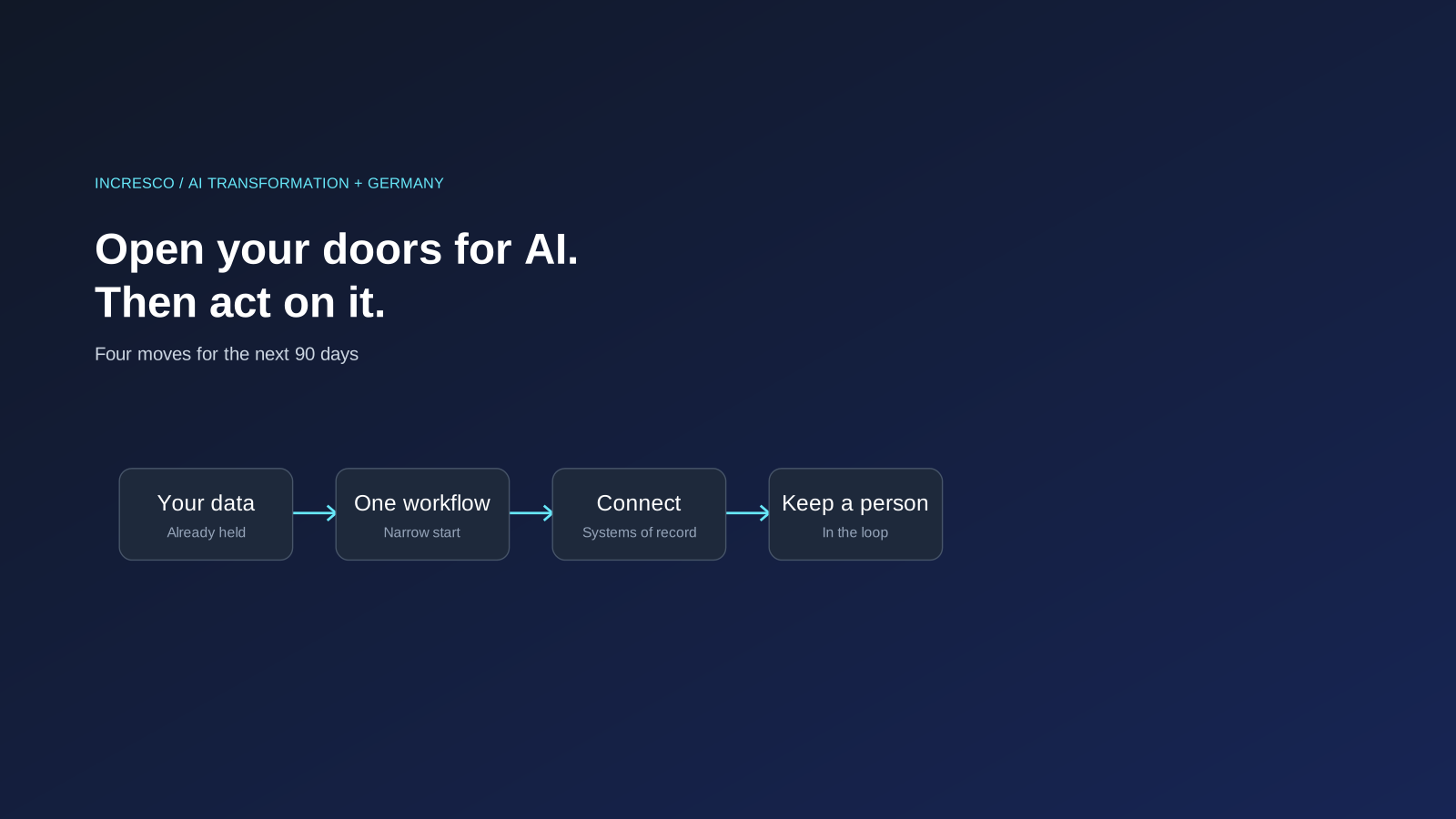
How to Start: Four Moves for the Next 90 Days
These steps show how AI agents work in production.
1. Use the Data You Already Hold
Orders, tickets, bookings, machine logs and contracts already sit in your systems. List which data is clean, who owns it, and what may leave your network. This is Merz’s point, and it is where your edge starts.
2. Pick One Narrow Workflow
Choose a task that happens often, sits in one system and can be checked. Start there. A narrow start gives you proof in weeks and a pattern you can repeat.
3. Connect It to Your Systems of Record
An agent is only as useful as the records it can read and the actions it may take. For each system, decide what the agent can read and what it can write. Plan system integration as core work. It is a major cost for 41% of German AI users.
4. Protect the Data and Keep a Person in the Loop
Confirm the legal basis, contracts and data location before real customer data is used. Check your duties under the GDPR and the EU AI Act. Send anything that affects money, contracts or safety to a person. Incresco publishes its own data-processing agreement for review.
What the first workflow looks like by sector: scheduling or quality checks in manufacturing, booking checks in hospitality, tenant questions in real estate, enrolment questions in education, and document review in financial services.
The Rule to Adopt
Before any AI workflow goes live, give it one owner, one system of record and one measure of success.
If you cannot name all three, the workflow is not ready. If you can, you have a project that can grow from one team to the whole company.
How Incresco Helps You Move From Planning to Production
Awareness is the first step. A working plan is the harder one. Incresco does this with you as your AI transformation partner:
- Find the first workflow. We map your data and processes and pick the use case that pays back first.
- Choose where it runs. We help you decide between on-device, private cloud and public cloud for each task, and write down the reasons.
- Connect your systems. We link CRM, ERP, billing and records, so the agent works from live data.
- Build and run a pilot. We build AI agents on Salesforce, WhatsApp, web and mobile, with clear rules for access, storage and review.
See our AI transformation and AI strategy services.
Do three things this week. List the five questions or checks your team repeats most. Pick the one that sits in a single system. Then contact Incresco and ask for an AI readiness review. We will map your processes and data, and tell you where to start.
Merz asked German companies to open their doors. Most of your rivals already have.
Sources: Reuters via Investing.com, October 19, 2026; CNBC, October 2026; Reuters, October 19, 2026 (summit); The Next Web; AI News; Bitkom, September 2026; ifo, June 2026; EY via dpa; Bloomberg, October 2, 2026; Destatis figures via Startbase; IW via dpa.
Related Articles
Related Articles
Engineering
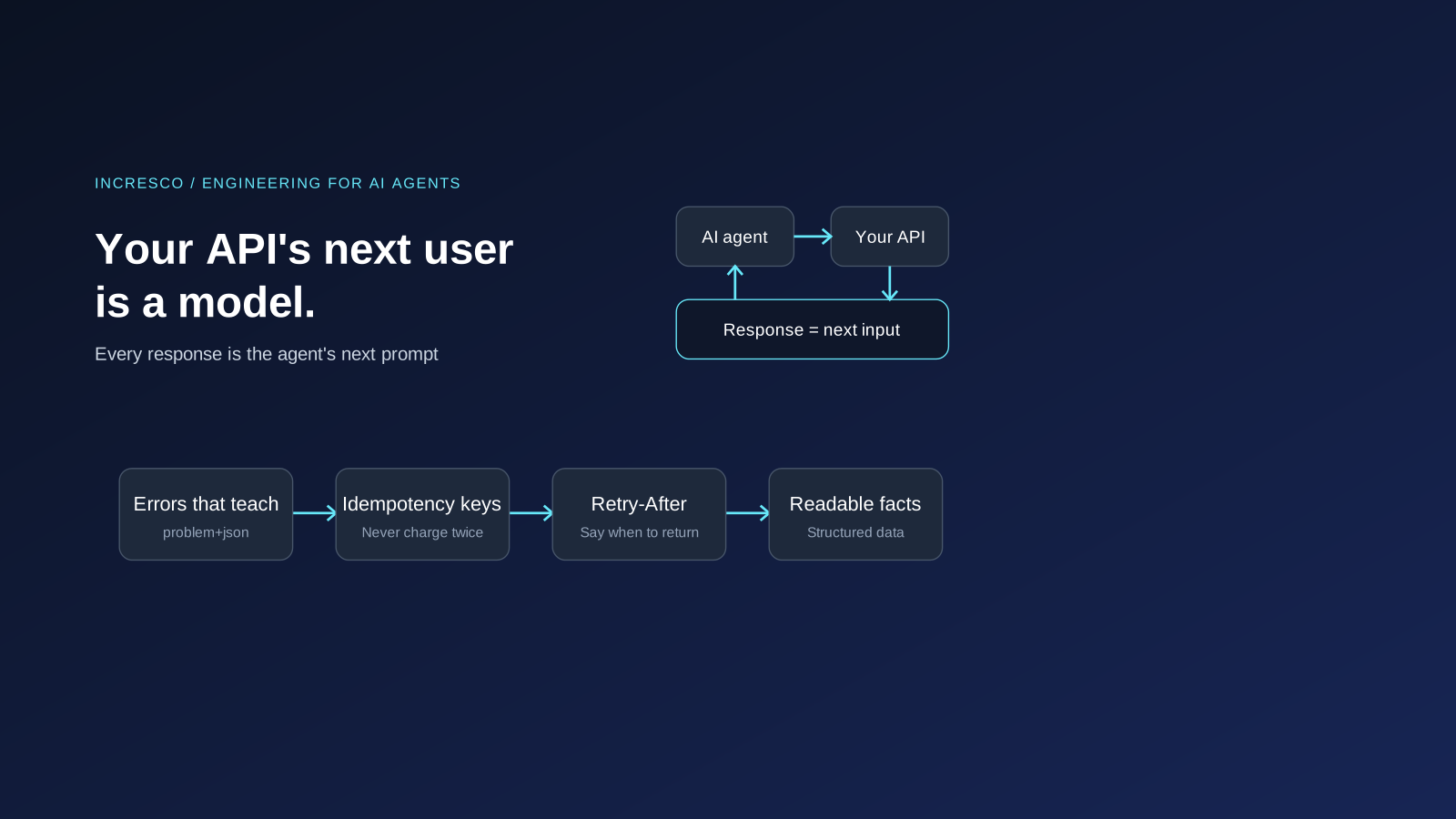
Your API's Next User Is a Model: Agent Experience (AX) for Engineers
AI agents call your API and treat each response as their next prompt. Engineering for them: clear errors, idempotency keys, rate limits and MCP tools.
Read Insight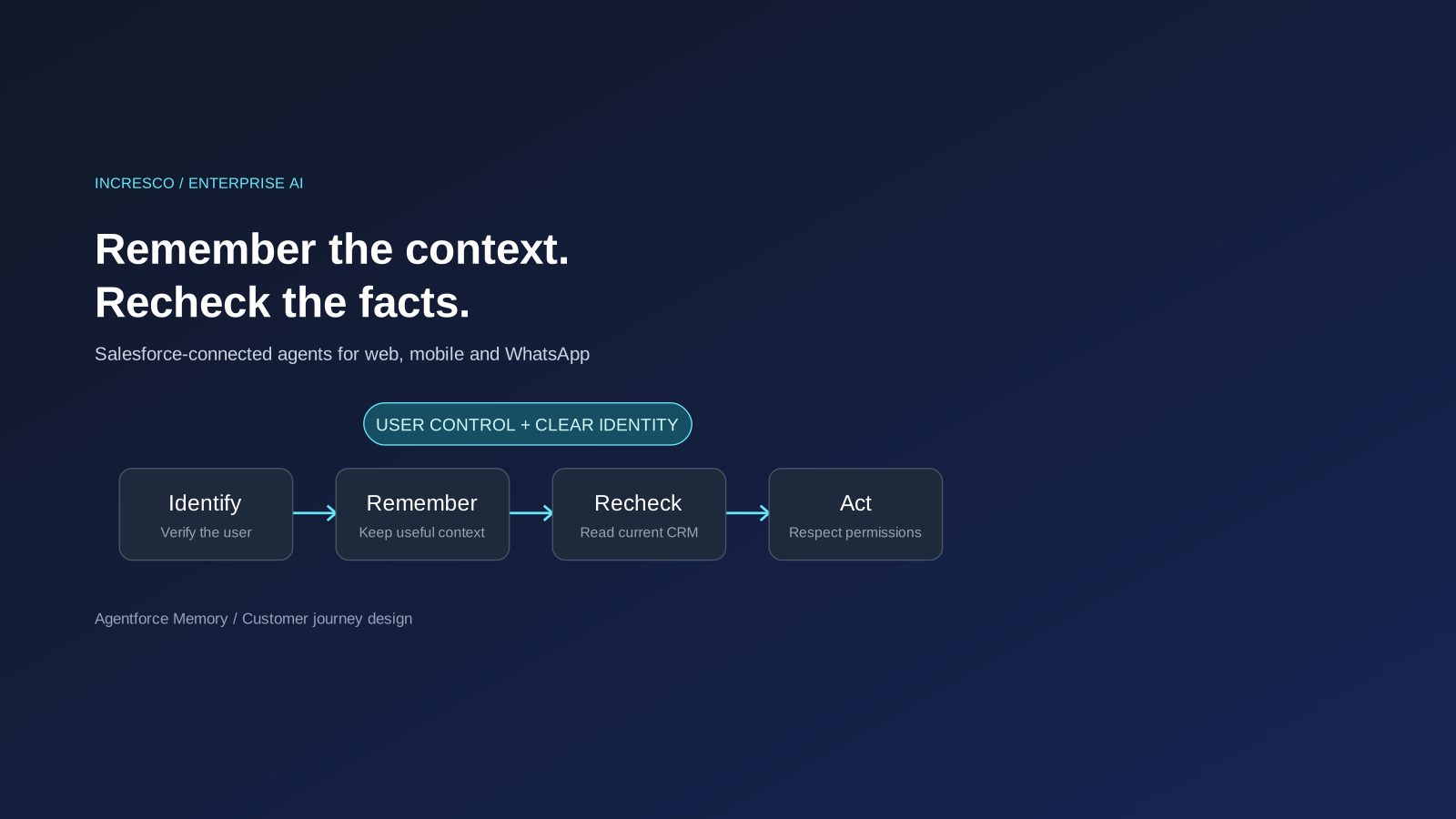
Business
Agentforce Memory: What Salesforce and WhatsApp AI Agents Should Remember
Salesforce's new Agentforce Memory engineering article explains persistent context. What should web, mobile and WhatsApp AI agents remember, refresh or forget?
Read Insight