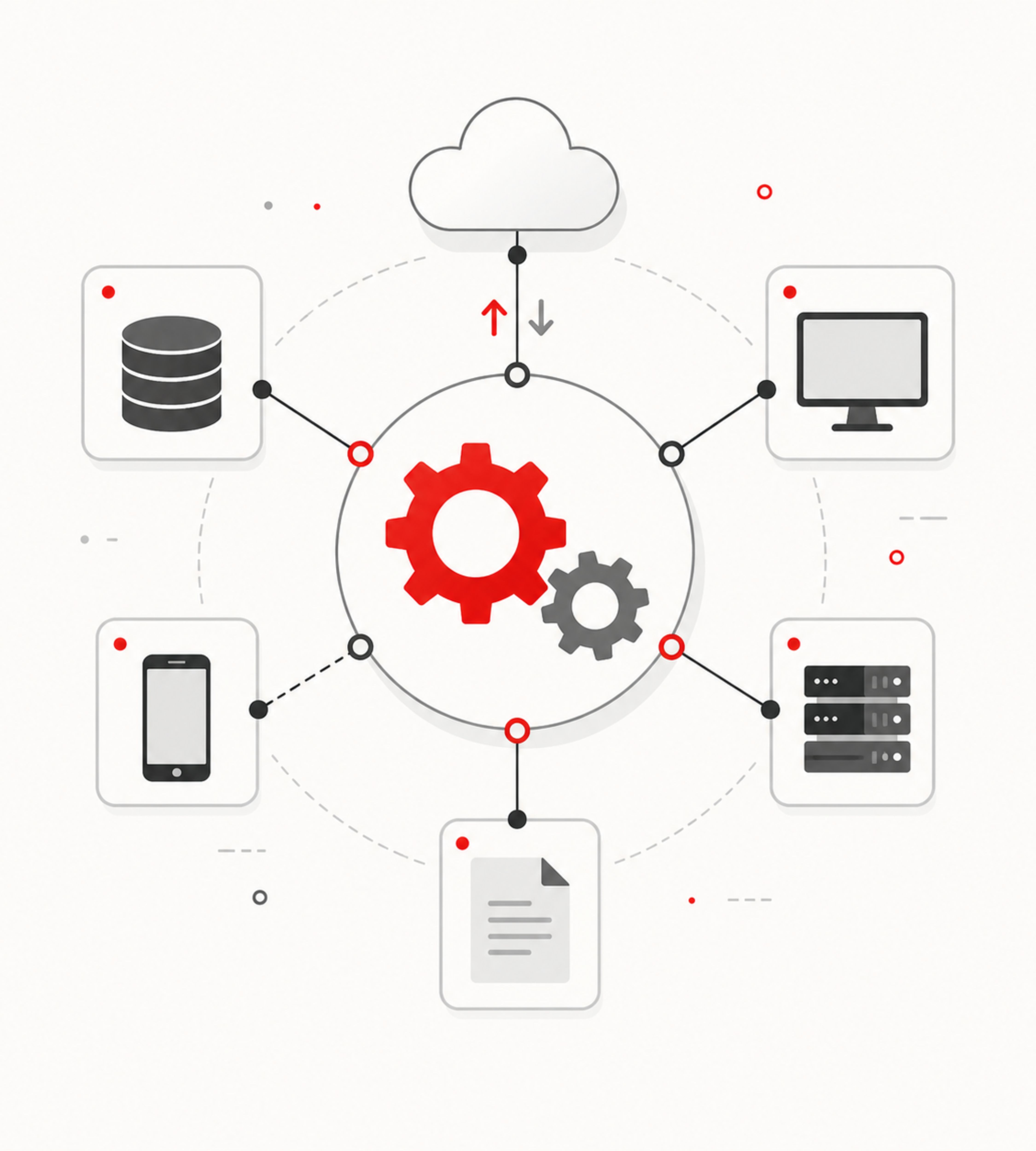
Disconnected systems create operational friction, fragmented visibility, and unnecessary manual work. We help organizations integrate CRM, ERP, billing platforms, and third-party applications into a unified operational environment.
System integration is often approached as a technical implementation exercise. In practice, it is an operational alignment initiative—ensuring that business-critical systems exchange data consistently, workflows remain connected, and teams can operate without fragmentation across departments and platforms.
1
Integration Strategy & Architecture
Define how systems should communicate across the organization while aligning integrations with operational priorities, scalability requirements, and long-term technology goals.
2
Unified Data Flow
Establish reliable synchronization between CRM, ERP, billing, analytics, and internal systems to eliminate duplication, reduce inconsistencies, and improve visibility across operations.
3
Workflow & Process Automation
Connect systems in ways that automate repetitive operational processes, reduce manual intervention, and improve execution speed across teams.
4
Reliability, Security & Governance
Build integrations with enterprise-grade security, monitoring, access controls, and failover mechanisms to ensure continuity and compliance as systems scale.
4-Phase Integration Framework
Our 4-Phase System Integration Framework
A structured approach to move from disconnected systems to a unified operational ecosystem. In practice, this ensures integrations are scalable, secure, and aligned with business operations rather than implemented as isolated technical connections.
1
Discovery & Assessment
Establish a clear understanding of the current technology landscape, operational dependencies, and integration gaps. This phase focuses on identifying where fragmentation creates the greatest operational inefficiencies.
Evaluation of existing systems and workflows
Assessment of integration dependencies and bottlenecks
Identification of critical data flows and operational risks
Prioritization of high-impact integration opportunities
2
Integration Strategy & Planning
Translate operational requirements into a scalable integration roadmap. The emphasis here is on designing architectures that support reliability, flexibility, and long-term maintainability.
Development of integration architecture and standards
Selection of platforms, middleware, and technologies
Creation of phased implementation roadmap
Planning for governance, monitoring, and scalability
3
Implementation & Deployment
Execute integrations with minimal operational disruption while ensuring system reliability and data consistency across environments.
API and middleware implementation
System connectivity and data synchronization setup
Workflow automation and orchestration
Validation, testing, and deployment support
4
Optimization & Scale
Continuously improve integration performance and expand connectivity as operational requirements evolve over time.
Monitoring and performance optimization
Continuous refinement of workflows and automations
Enhancement of reporting and visibility layers
Expansion of integrations across business functions
Where we create value?
Where System Integrations Deliver Measurable Impact
We focus on integration initiatives that remove operational bottlenecks and improve coordination across business functions. In many cases, the greatest impact comes from eliminating disconnected workflows and enabling real-time visibility between systems that teams rely on every day.
01
Sales, CRM & Customer Operations
Disconnected customer systems often create delays, duplicate work, and inconsistent customer experiences. Integrated workflows allow teams to operate with greater accuracy and responsiveness.
CRM and ERP synchronization for unified customer records
Automated lead, order, and billing workflows
Real-time customer activity and status visibility across teams
02
Finance, Billing & Revenue Operations
Financial operations become more reliable when billing systems, payment platforms, and operational systems remain continuously aligned.
Automated invoice, payment, and reconciliation workflows
Integration between billing, accounting, and ERP platforms
Centralized financial reporting and operational visibility
03
Internal Operations & Enterprise Systems
Operational efficiency improves when internal tools and business systems communicate without dependency on manual coordination.
Workflow automation across departments and teams
Centralized dashboards and operational reporting
Integration of legacy systems with modern cloud platforms
Featured Insights
Proven Operational Impact
Integration initiatives that remove fragmentation, improve coordination, and build the operational infrastructure organizations need to scale reliably.
30–50%
Reduction in Manual Operational Work
Delivered through workflow automation, synchronized systems, and elimination of duplicate data handling.
Faster
Decision-Making Through Unified Visibility
Enabled by real-time synchronization across CRM, ERP, finance, and operational platforms.
Scalable
Operational Infrastructure
Integration architectures designed to support future growth, platform expansion, and evolving business requirements.
FAQs
What Organizations Usually Ask Us
System integration involves connecting business-critical platforms such as CRM, ERP, billing, analytics, and internal tools so they can exchange data reliably and support unified workflows. The objective is to reduce fragmentation and improve operational continuity across teams.
Most modern platforms provide APIs or integration capabilities. This includes CRM systems, ERP platforms, billing tools, cloud applications, data platforms, internal applications, and many legacy systems through middleware or custom integration layers.
Yes. Many organizations operate with a mix of modern and legacy infrastructure. In practice, integrations are designed around existing operational realities while progressively modernizing connectivity and reducing dependency on manual processes.
Data consistency is managed through synchronization rules, validation logic, monitoring systems, and governance controls. This helps ensure that business-critical information remains accurate and aligned across platforms.
All integrations are designed with enterprise-grade security controls, including authentication, encryption, access management, auditability, and monitoring. Integration architectures are aligned with existing compliance and governance requirements.
Yes. Integration architectures are designed to evolve alongside operational growth. This allows organizations to add new platforms, automate additional workflows, and expand system connectivity without rebuilding foundational infrastructure.
Ready to unify your systems and eliminate operational silos?
Cookie Preferences
Necessary cookies keep this site running and don't require your consent. With your permission, we'd also like to use optional cookies — analytics and session recording — to understand how the site is used so we can improve it. Privacy Policy
Cookie Preferences
Choose which categories of cookies you allow. Necessary cookies keep the site working, don't require consent, and can't be turned off. Optional cookies are off unless you turn them on.
NecessaryAlways Active
Required for core site functionality, such as remembering your cookie choices. Doesn't require consent and cannot be disabled.
Details
Name
Purpose
Duration
cookie-consent
Remembers your cookie choices so this banner doesn't ask again.
180 days
Analytics (optional)
We use Google Analytics and Zoho PageSense to understand how visitors use the site so we can improve it. Off by default and used only with your consent.
Google Analytics
Via Google Tag Manager. Helps us understand page views and site usage.
Details
Name
Purpose
Duration
_ga
Distinguishes unique visitors for Google Analytics reporting.
2 years
_ga_<container-id>
Persists session state for this property in Google Analytics (GA4).
2 years
_gid
Distinguishes unique visitors for Google Analytics reporting.
24 hours
Zoho PageSense
Heatmaps and session recordings that show how visitors use the site.
Details
Name
Purpose
Duration
zabUserId
Anonymous visitor ID used by Zoho PageSense.
1 year
zabBotScore
Used by Zoho PageSense to tell visitors apart from automated traffic.
1 year
zabHMBucket
Used by Zoho PageSense for heatmap reporting.
1 year
zps-tgr-dts
Used by Zoho PageSense to store visit tracking details.
1 year
zpsCookieMeta
Used by Zoho PageSense to manage its own cookies.
400 days
zsc<project-id>, zsd<id>, zsr<id>, zft-sdc
Zoho PageSense session tracking for heatmaps and session recordings.
Up to 1 day
ps_payloadSeqId
Orders the data Zoho PageSense sends during a visit.