Blog Article
Agentforce Memory: What Salesforce and WhatsApp AI Agents Should Remember
Salesforce's new Agentforce Memory engineering article explains persistent context. What should web, mobile and WhatsApp AI agents remember, refresh or forget?

A customer starts on your website, returns through your mobile app and asks for help on WhatsApp. Should your AI agent ask them to explain everything again? Or should it remember what happened before? The harder question is what it must check again before acting.
Salesforce’s October 5, 2026 engineering article, AI Agents Need Memory, puts that problem in focus. It describes the development of Agentforce Memory from proof of concept into pilot, including retrieval tradeoffs and user controls. For businesses building Salesforce-connected apps and AI agents, the lesson is practical: continuity needs a design, not just a longer chat history.
What Is Agentforce Memory?
According to Salesforce’s engineering team, Agentforce Memory is designed to carry relevant information from previous interactions into later ones. Its goal is to reduce the repeated explanations associated with stateless agents.
The team says it began by adding conversation history and user profile information to the agent’s context. It then explored retrieval of relevant older information, rather than relying only on the latest messages. The article describes integrating memory into the Reasoner so that curation, retrieval and context injection can happen within the platform.
A useful distinction follows: stored memory is not the same as the context used for one answer. Keeping information does not mean every item should be loaded into every conversation. Salesforce discusses tradeoffs between retrieval quality, latency and context size, and describes keyword matching before reasoning in its chosen approach.
These are Salesforce’s descriptions of its engineering work. We have not independently tested the feature or its performance.
Is Agentforce Memory Generally Available?
Do not read this week’s engineering article as a general-availability announcement. It describes the journey into pilot and preparation for production, but does not provide a public GA date, a complete edition or region matrix, or confirmation that your Salesforce org has access.
Before planning an implementation, confirm your org’s current feature access, supported agent types and channels, user controls, storage and retention limits, and applicable pilot conditions with Salesforce. We deliberately do not copy configuration instructions or numerical limits from third-party tutorials without matching them to current official documentation for your setup. This post makes no pricing claims.
A separate Salesforce Winter ‘27 architecture guide, also dated October 5, describes multi-agent orchestration and handoff across Embedded Chat v2, WhatsApp and mobile. That does not establish that Agentforce Memory is automatically available across those channels or that identities and memories are shared between them.
The Business Implication: Remembering More Can Also Mean Repeating a Mistake
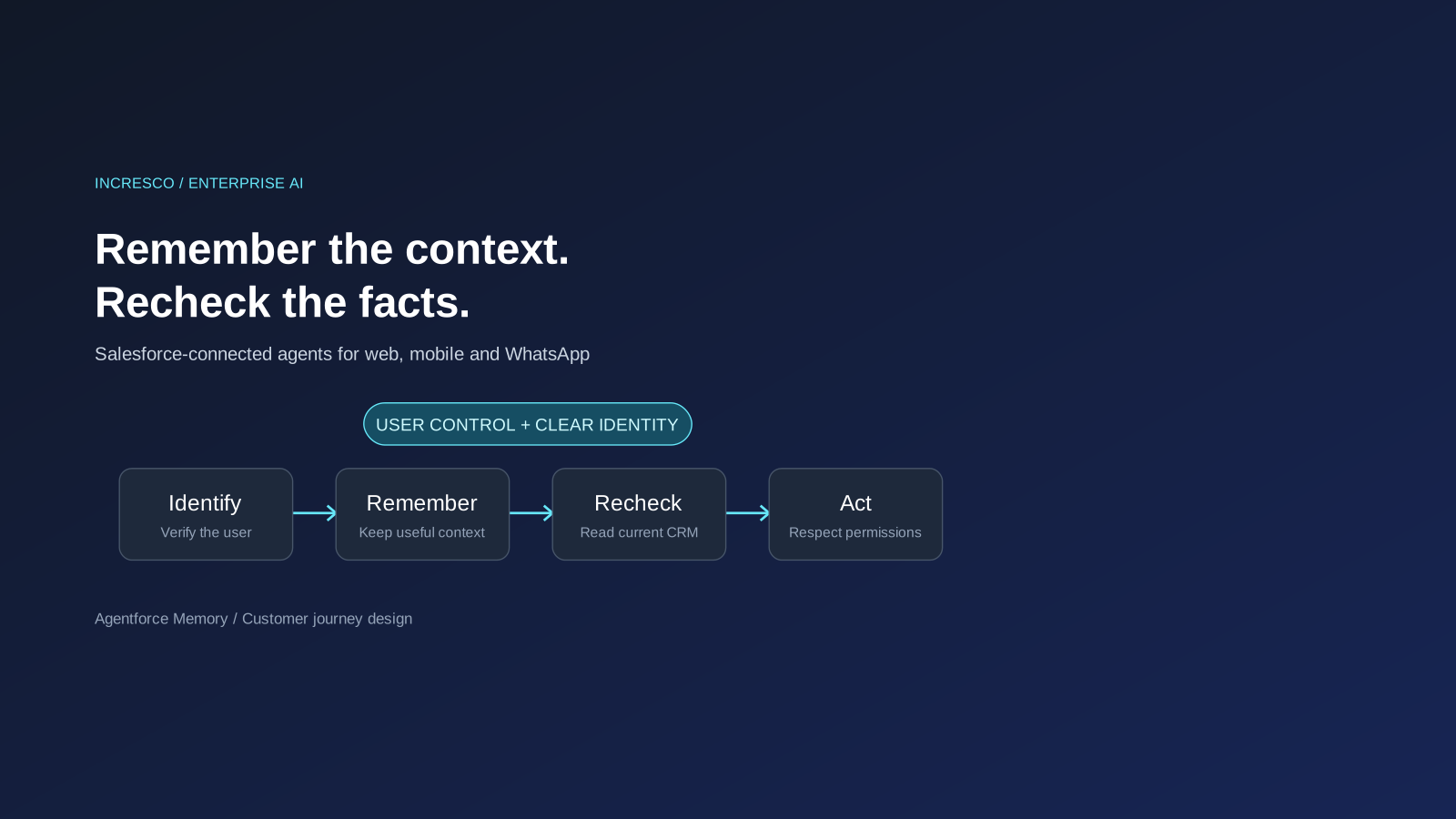
Our view: a useful customer experience avoids unnecessary repetition without turning yesterday’s conversation into today’s authority.
Consider a hypothetical customer who said last month that they preferred delivery to an office. That may be useful context for a later conversation. It is not confirmation of the address for a new order. Likewise, a remembered statement that a support issue is unresolved should not override a current Salesforce case record showing it was closed.
For web, mobile and WhatsApp journeys, the risk also includes identity. Before reusing personal context, your application needs to establish whose context it is and whether it is appropriate to use on that channel. A familiar name or a phone number alone should not become a shortcut around your identity and access checks.
The commercial goal is not to maximise the amount remembered. It is to reduce repeated questions while preserving accurate decisions, appropriate access and a clear path to a person when the agent is unsure.
What to Change in Your Salesforce-Connected AI Agent
The following is Incresco’s implementation advice, not a claim about features automatically supplied by Agentforce.
Separate Preferences From Current Business Records
Define which information can be remembered and which must be retrieved fresh. A communication preference may be suitable for memory under your policy. Order status, case ownership, account eligibility and approval state should come from the current authoritative system before they drive an action.
Attach a source and time to remembered information. When it conflicts with a current record, make the conflict visible rather than silently choosing the more convenient answer.
Design Identity Across Web, Mobile and WhatsApp
Map how an authenticated app user relates to a Salesforce contact and a WhatsApp conversation. Define verification and account-switching rules. Test shared devices, reassigned phone numbers and two people with similar names.
Do not assume that enabling a channel creates a safe cross-channel memory model. Your integration must preserve the intended user and data-access boundary.
Give People a Way to Inspect, Correct and Forget
Salesforce says its team introduced user preferences to enable or disable memory globally or for individual agents, and a console to review, edit and manage stored memories. It says conversational controls are also being extended to channels without the standard interface.
For your own product, define the user journey for those controls. A mobile app may expose settings directly; a WhatsApp flow may need a clear explanation and an accessible route to manage memory. Verify what the deployed product actually supports. Do not promise a control merely because an engineering article discusses it.
Test Stale, Missing and Wrongly Matched Memory
A successful test is not only “the agent remembered a preference”. Also test that it:
- Does not retrieve another customer’s information.
- Notices a preference that has changed.
- Says it does not know when no reliable memory exists.
- Respects a request to stop using or delete remembered information under the product’s policy.
- Checks current CRM data before changing a record or making a commitment.
Start with one narrow journey and compare repeated questions, completion rate, incorrect answers and human handoff quality with the baseline. Expand only after the failure cases work as intended.
How Incresco Helps
Incresco builds web and mobile applications, cloud integrations, Salesforce solutions, WhatsApp experiences and AI agents. A memory-aware customer journey sits where those services meet: the interface, customer identity, CRM records and agent actions need to work together.
Our AI transformation approach starts with business outcomes, data readiness and operational integration. For this kind of project, we recommend mapping one customer journey, defining the memory and CRM boundaries, implementing the required integrations, and testing both useful recall and safe failure.
Incresco has built similar solutions for clients. Contact Incresco to discuss a Salesforce-connected web, mobile or WhatsApp AI-agent pilot.
Sources and Scope
- Salesforce Engineering, October 5: Agentforce Memory design, pilot context, retrieval and user-control descriptions.
- Salesforce Winter ‘27 architect highlights, October 5: channel orchestration context, not evidence of memory availability on every channel.
- Incresco services and AI transformation: our published service scope.
Sources checked October 7, 2026. Vendor engineering descriptions are attributed, availability remains org-specific and unverified, and the implementation recommendations are ours.
Related Articles

Engineering
From AI Assistant to AI Engineer: How Agentic Coding Changes the SDLC
Discover how AI coding agents are transforming the SDLC, from requirements and development to testing, deployment, and engineering roles.
Read Insight
Business
AI Agent Identity: Why Every AI Agent Needs Its Own Login (IBM watsonx Orchestrate)
IBM added Agent Identity to watsonx Orchestrate. What AI agent identity means, why shared API keys are a risk, and what to set up before agents touch your systems.
Read Insight