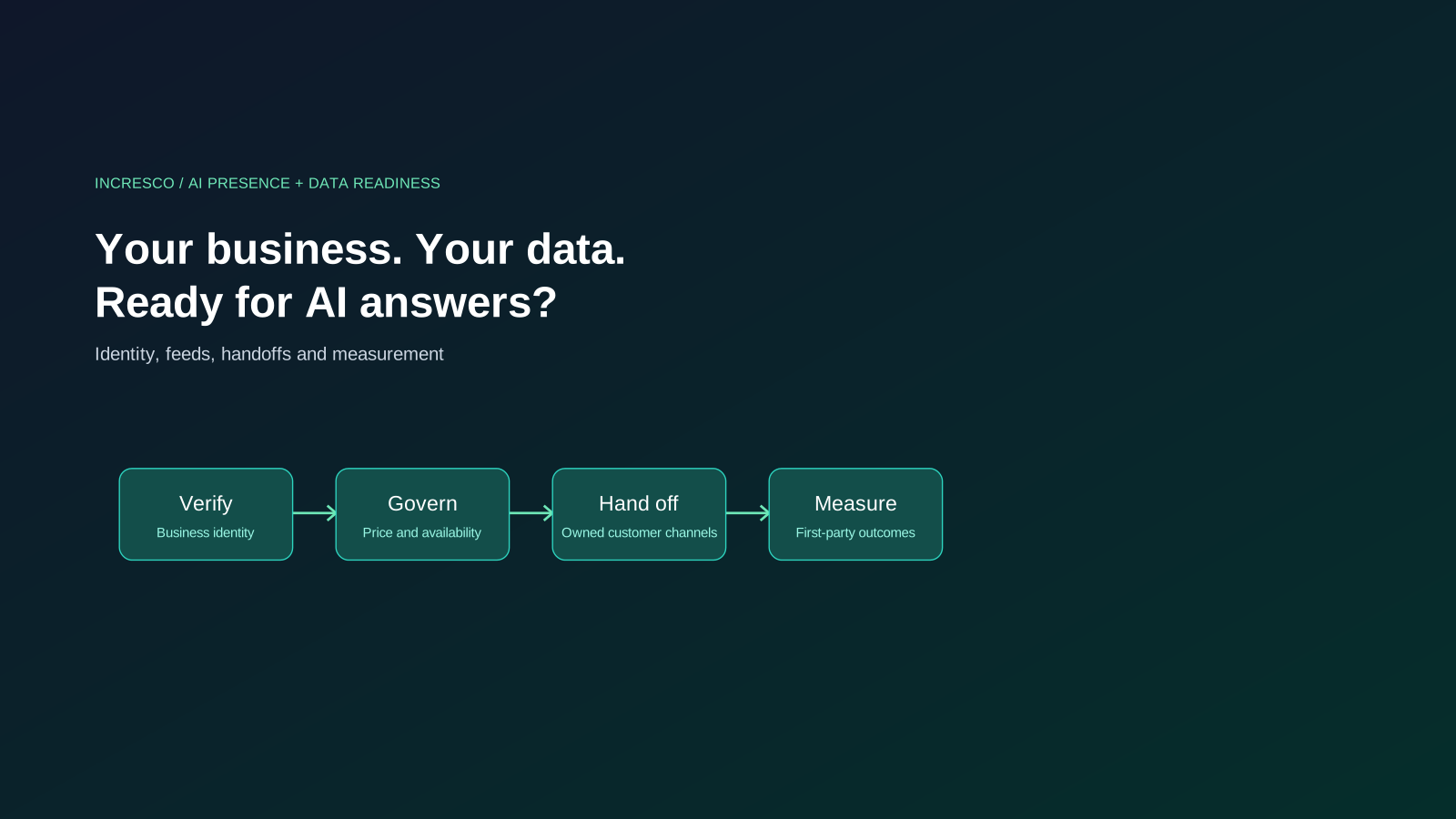
Blog Article
ChatGPT Is Answering Questions About Your Business. Is Your Data Ready?
Businesses in ChatGPT beta makes accurate business data a priority. Learn the verification, product-feed, eligibility and customer-handoff limits before you plan.

A problem-first look at OpenAI’s “Businesses in ChatGPT” beta, and the data architecture underneath a credible AI presence.
On November 10, 2026, OpenAI introduced “Businesses in ChatGPT” in beta. The headline features are easy to summarise: a business can claim and verify its profile, publish accurate information, connect product feeds, see aggregated engagement insights, and, for eligible businesses, launch a Business Agent that chats with customers inside ChatGPT.
The harder question sits underneath the announcement. ChatGPT is already answering questions about your business, whether you manage that presence or not. OpenAI says more than a billion people use ChatGPT each week, and those people increasingly ask it what to buy, where to stay, and which provider to trust. The answers are assembled from whatever data the model can find. If your prices, availability, policies and descriptions live in systems that were never designed to feed a machine-readable channel, the version of your business that customers meet in ChatGPT risks being stale, incomplete, or written by someone else.
This article is about the architecture behind fixing that: what OpenAI actually shipped, what it does not do, and the data engineering that separates a claimed profile from a trustworthy AI presence.
What OpenAI actually announced
Three products, under one beta umbrella:
Business Hub is the management surface. A business claims its organisation, verifies the connection (by business phone, business email, a DNS TXT record on its website domain, or a connected Shopify store), and then completes identity verification with Persona before it can publish changes, connect a product feed, or view insights. After approval, the profile carries a blue check. Verified businesses can update their website link, description, category, logo, delivery and return policies, and optional details such as a cover photo.
Product feeds let a business share pricing and availability in a structured format. OpenAI accepts a CSV upload or a hosted feed URL that follows its product feed specification, and Shopify merchants can connect their catalog directly. Products in a feed must follow OpenAI’s Commerce policies.
Aggregated insights show how people engage with the business over the past 28 days: mentions, website clicks, and “discovery topics”, the common themes across ChatGPT answers that mentioned or cited the business. Insights are threshold-gated to protect privacy. Businesses never see individual prompts or conversations, including chats with their own Business Agent.
On top of these sits the Business Agent: a clearly labelled conversation with the business, separate from the user’s own ChatGPT thread and visually distinct from ChatGPT’s independent answers. The agent answers from the business’s own product and policy information, under instructions the business writes. Businesses can also sponsor their agent and use it as a destination for ChatGPT Ads.
The limits that matter before you plan
Read OpenAI’s setup documentation and Business Agents Policy before the strategy deck:
- Eligibility is gated twice. Claiming a profile is broadly available to eligible businesses where ChatGPT is offered, subject to location, business type, and verification checks. Business Agents are narrower: currently limited to eligible ecommerce and online service businesses in the United States with a website, and the Business Agents Policy adds industry-level requirements. OpenAI says access will expand to more markets and categories over time, but no timeline is published. Whether a specific hotel group, university, or travel operator qualifies today is a check to run against the current policy, not an assumption to make from the announcement.
- Claiming buys accuracy, not ranking. OpenAI states plainly that claiming does not guarantee higher placement or sales, and that advertising does not influence ChatGPT’s independent answers. ChatGPT may also keep using other sources when it answers questions about you.
- Agents cannot transact. A Business Agent can explain products and policies and link to your website. It cannot complete a purchase, make a booking, or check an order status. Every conversion still happens on infrastructure you own.
- Insights are aggregates with floors. A blank metric does not mean zero activity; it can mean the reporting threshold was not met. There are no query logs, no conversation exports, no intent reports.
None of this makes the announcement small. It makes it a data problem rather than an advertising problem.
The architecture underneath a credible AI presence
Treat “showing up correctly in ChatGPT” as an engineering system with four layers. Each has its own failure modes.
Layer 1: Identity and verification
The claim flow is an identity pipeline, not a signup form. Verification can go through SMS or an automated call to a registered business number, an email on the business domain, a DNS TXT record, or a Shopify connection, and publishing changes requires Persona identity verification, which may require a government-issued ID, business registration information and proof of authorisation.
Two operational consequences follow. First, the claim sits with whoever can complete one of the offered verification methods and then the Persona identity check, which can require a government-issued ID, business registration details and proof of authorisation to represent the business. In most organisations that means coordinating IT, legal and marketing rather than delegating it to whoever manages social media. Second, OpenAI states that each distinct brand is managed separately, that central management across a parent company’s brands and locations is not currently available, and that claiming the main brand does not claim its locations. For a business with several brands or locations, each is its own claim and verification effort.
If someone else has already claimed your business, there is a dispute path, but it runs through the same identity verification. The tradeoff is familiar from Google Business Profile and app store verification: the friction is the security model.
Layer 2: The product feed as a data pipeline
The feed specification is where the announcement stops being marketing and becomes schema design. OpenAI’s product feed specification requires nine fields per row: item_id, title, description, url, brand, seller_name, image_url, availability, and price. Availability is an enum (in_stock, out_of_stock, pre_order, backorder, or unknown), and an empty or unrecognised value rejects the row. Variants are modelled explicitly: each sellable variant is its own row with a distinct item_id, linked by a shared group_id and a variant_dict of selected options, with listing_has_variations=true on each variant row and offer_id available to distinguish offers that share a product URL. Identifiers must stay stable when prices, stock or images change.
That contract forces decisions most businesses have never made cleanly:
- What is the source of truth? The feed has to be generated from the system that actually knows price and availability: the ecommerce platform, the ERP, or, in hospitality terms, the PMS and booking engine. If the website front end is the only place where price and stock meet, someone has to build that join first.
- How fresh is fresh enough? For a hosted feed URL, design for ingestion delay rather than assuming immediate updates: OpenAI notes that changes can take time to appear in answers. A nightly export that was acceptable for a comparison-shopping feed may be wrong for a channel where a customer is mid-conversation. The tradeoff is between feed regeneration cost and the support burden of stale prices.
- What is your variant model? One way to see it: if a business whose offer is not a classic product, say a hotel thinking about room types with different rate plans, wanted to describe that offer in feed terms, it would be modelling variant groups in exactly this sense. That is an internal modelling analogy, not a documented capability: the specification is written for purchasable products, and whether a given service or booking inventory fits the feed and the current policies is a check to run, not an assumption to make. Businesses whose catalogs never needed formal variant IDs, which includes most service businesses, will be inventing identity rules as they go. The spec’s rule that an
item_idmust never be reused for a different item sounds trivial until a catalog migration renumbers everything.
The feed is also a governance surface. The Business Agents Policy requires that information be kept current and forbids instructing an agent to invent prices or availability. A feed that silently disagrees with the website is not just a data bug; it is a policy exposure in a channel where the business is formally accountable for what its agent says.
Layer 3: The agent conversation, and the handoff out of it
A Business Agent answers from the information and instructions the business provides, and OpenAI’s policy draws the boundaries clearly: the agent must be transparent that it is AI representing the business, it must not fabricate offerings or guarantees, it must not pressure users or harvest unnecessary personal data, and it must stay within its approved role.
Since the agent cannot transact, its real job is qualification and routing. The customer asks which of two options fits their needs; the agent answers from your data; then the customer has to go somewhere to act. That “somewhere” is a design decision. The naive version links to the homepage and loses the thread. A better version uses the links the agent can offer deliberately: a deep link to the exact product or programme page the conversation was about, or a path into the business’s own web chat or WhatsApp channel, where, when appropriate, a human can join the loop.
Be precise about what crosses that boundary. The business never sees the ChatGPT conversation, not even chats with its own agent, and the current setup documentation describes no conversation export or integration API. So the handoff cannot carry the conversation with it: context on your side has to come from the destination the customer chooses (the page the link points to), from what the customer tells you, or from data you are separately permitted to use. Your CRM recognises the customer only once they identify themselves in your channel. Designing that arrival experience, and being honest about where the context ends, is the real integration work: OpenAI provides the conversation surface, not the connection into your systems.
Layer 4: Measurement that respects the channel’s limits
The insights OpenAI provides are deliberately narrow. A “mention” for an online business counts when ChatGPT references the business’s website; naming the brand alone does not count. Website clicks are click-throughs. Discovery topics are aggregate themes, explicitly not individual prompts and explicitly not a direct measure of customer intent. Everything is a 28-day aggregate with privacy thresholds, and a blank metric can mean the threshold was not met.
Architecturally, this means first-party measurement has to do the heavy lifting. Traffic arriving from ChatGPT should be identifiable in your own analytics through referral and campaign parameters on the URLs you control, so that feed-driven visibility can be tied to sessions, leads and bookings on your side. Businesses that treat OpenAI’s dashboard as a directional signal and their own instrumentation as the record of truth are best positioned to learn in this channel.
What this means if you are not eligible yet
If your business does not fall within the currently documented Business Agent categories, check your eligibility against the live policy before planning around one. That does not make this a waiting game.
ChatGPT shows information about businesses whether or not they have an agent, and OpenAI has said it plans to expand to more markets and categories. The work that improves how a business’s own information can reach AI answers - cleaning the source-of-truth data, structuring it into machine-readable feeds with stable identifiers, and designing the path from an AI conversation into owned channels - is the same work whether the consumer of that data is ChatGPT’s product feed today, another AI platform’s equivalent tomorrow, or the business’s own AI agent on its website and WhatsApp. The feed is an asset; the platforms are interchangeable consumers of it. None of it controls an AI platform’s independent answers, but all of it raises the odds that accurate information is available when those answers are written.
The organisations best positioned will not be the ones that claimed a profile first, but the ones whose data is ready if and when their category opens up.
The Rule to Adopt
Treat AI presence as a governed data product, not a ranking shortcut. Give every price, availability and policy field a source of truth, an owner and a freshness check. Verify eligibility separately, and design handoffs without assuming private ChatGPT conversations travel into your CRM.
Availability and eligibility reflect OpenAI’s published documentation as of November 11, 2026 and may change during the beta.
How Incresco Helps
Incresco is an OpenAI partner. Incresco is a Claude partner. For a business looking at Businesses in ChatGPT, we would start with your numbers and your systems: where price, availability and policy truth lives today, what a compliant feed pipeline from those sources could look like, how an agent’s instructions and guardrails should be designed under OpenAI’s policies, and how conversations could hand off into channels you already own, such as your website, Salesforce workflows or WhatsApp.
Where the current eligibility rules do not yet cover your category, we can help prepare the data and integration layer so you are ready if they do, and put the same foundation to work in channels that are already open to you.
Read our analysis of AI agents in university admissions and AI for hotel operations beyond chatbots. Our AI transformation and system integration work connects these decisions to your existing systems.
Contact Incresco for an AI data-readiness review. We will review your source systems, feed requirements, freshness controls and customer handoff plan, with current eligibility and platform limits made explicit.
Related Articles
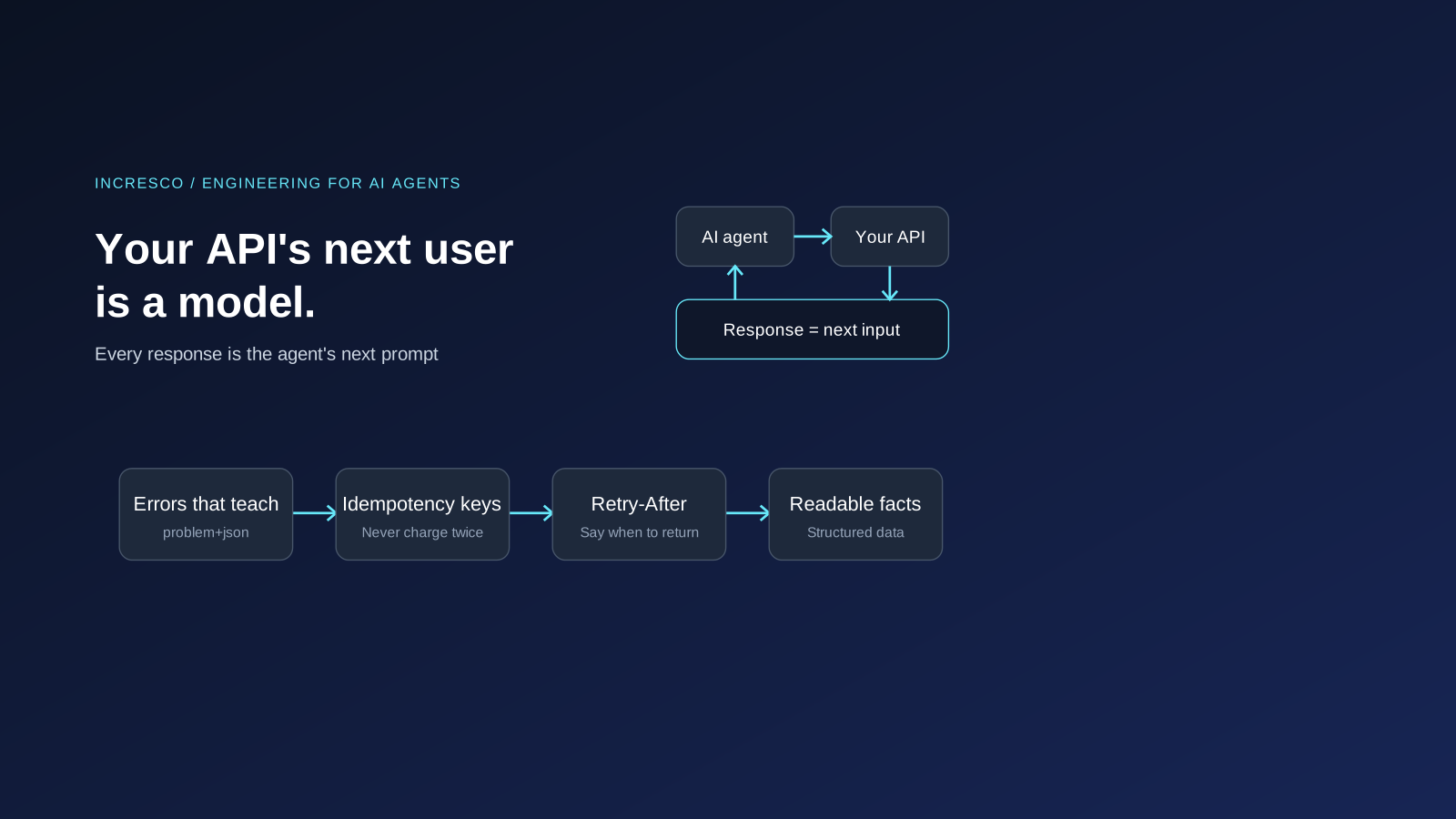
Engineering
Your API's Next User Is a Model: Agent Experience (AX) for Engineers
AI agents call your API and treat each response as their next prompt. Engineering for them: clear errors, idempotency keys, rate limits and MCP tools.
Read Insight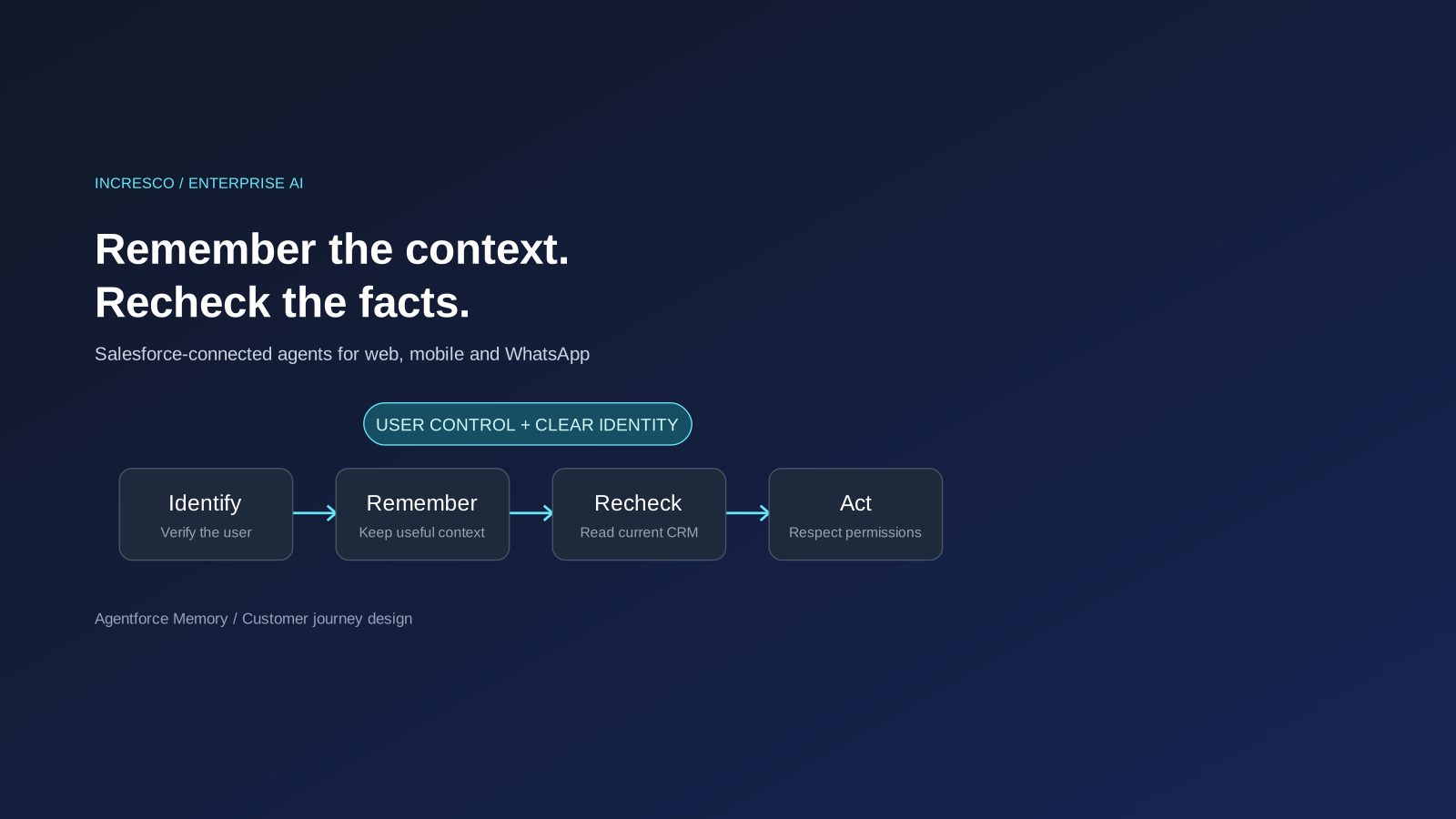
Business
Agentforce Memory: What Salesforce and WhatsApp AI Agents Should Remember
Salesforce's new Agentforce Memory engineering article explains persistent context. What should web, mobile and WhatsApp AI agents remember, refresh or forget?
Read Insight