Blog Article
AI Agents in University Admissions: Lessons from INSEAD and NMIMS
Universities are deploying AI agents on Salesforce Agentforce and Education Cloud to answer prospect questions, guide programme choice and support lead-to-admission workflows. Published case evidence from INSEAD and NMIMS shows what is already live.

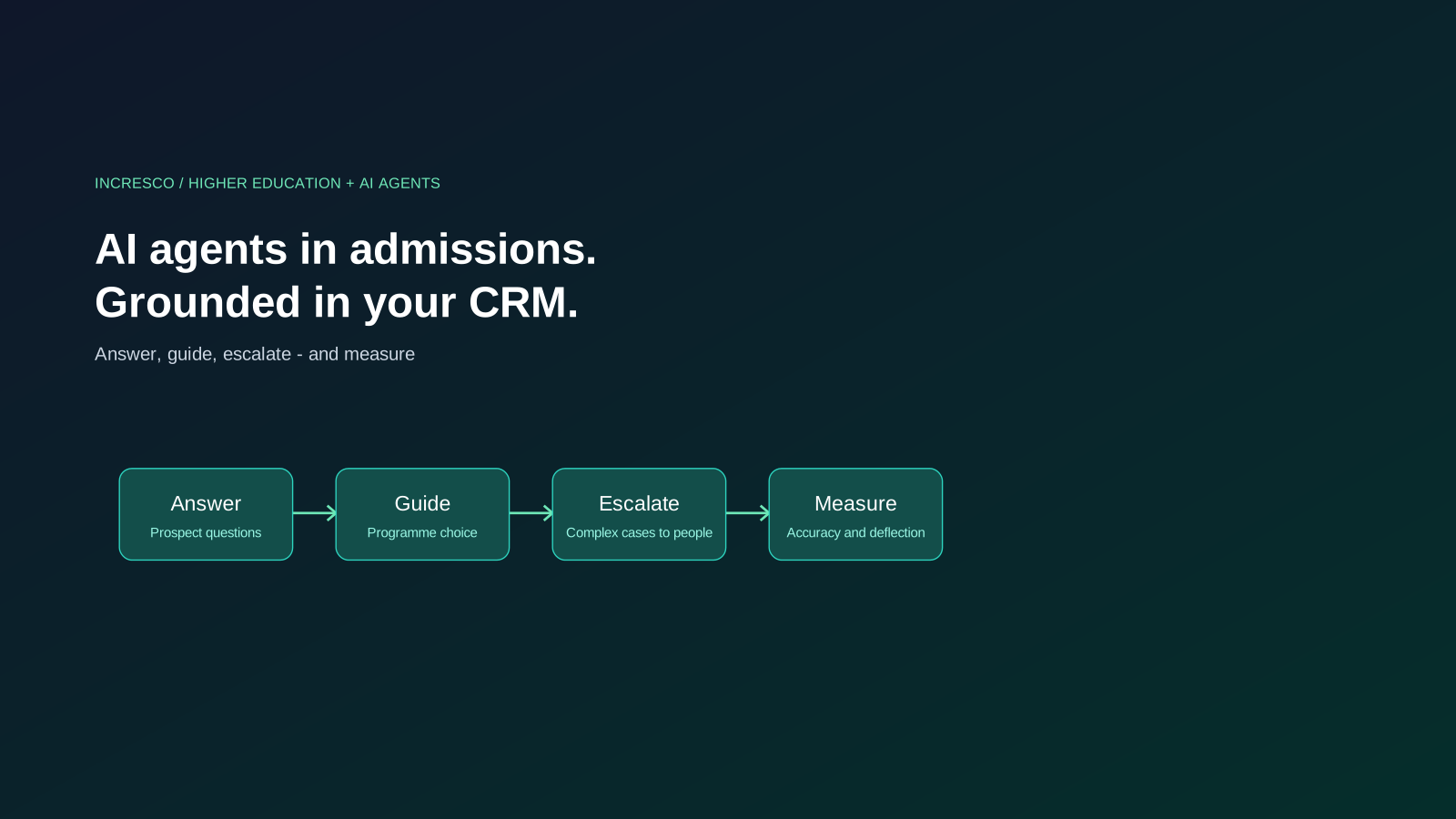
AI agents in university admissions are software agents that answer prospect questions, guide programme choice, capture interest and hand complex cases to humans, usually grounded in the institution’s CRM and content. In 2026 the clearest public implementations sit on Salesforce Agentforce for Education and Education Cloud, with published pilots such as INSEAD (with PwC) and NMIMS in India. They are not a replacement for admissions officers; they cut top-of-funnel delay and free staff for high-stakes counselling.
This article summarises what vendors and institutions have published, with links to the primary sources. It is a source-based analysis; it does not invent conversion lifts or claim unpublished client results.
What Is an AI Agent in University Admissions?
Salesforce describes Agentforce for Education as AI agents purpose-built for education on its CRM, with pre-built templates grounded in student, donor and institutional data. For recruitment and admissions, Salesforce’s Education materials highlight skills such as:
- Student recruitment - engage prospects with personalised outreach tied to goals and academic profile; answer questions; help start an application; register campus tours
- Financial aid inquiry - 24/7 guidance on applications, awards and requirements
- Transfer credit - estimate eligible courses, simplify transcript upload, give staff one place to map equivalencies
- Application and onboarding support - unify review, scoring and applicant portals inside Education Cloud, per Salesforce’s Recruitment and Admissions datasheet
In plain terms for a registrar or enrolment director: the agent sits on top of known programme content and CRM records, answers routine questions in minutes, and escalates when policy, edge cases or human judgement are required.
Why Are Admissions Teams Adopting Agents Now?
Three pressures show up repeatedly in higher-education digital programmes:
- Enquiry volume outpaces staff hours. Brochures, PDFs and multi-page programme sites still hold the answers, but prospects expect a conversational reply the same day.
- Multi-campus and multi-programme portfolios. Applicants need help comparing locations, entry requirements and deadlines without waiting for email.
- Yield and melt risk after offer. Institutions want consistent reminders, portals and care plans. Salesforce’s Education Cloud materials explicitly list summer-melt care plans and alert frameworks among recruitment and admissions capabilities.
Agents address the first mile (discovery and FAQ) so humans spend time on selection interviews, scholarship exceptions and conversion conversations.
What Results Have Institutions Published?
Public, attributable figures matter more than vendor slogans. Two 2026 sources are useful.
INSEAD (with PwC and Salesforce)
PwC’s case study (13 October 2026) describes one of the early Agentforce implementations in higher education. Key published points:
| Metric (as published by PwC) | Figure |
|---|---|
| Time to first live GenAI agent | About four weeks |
| Agent accuracy | 75-80% |
| Case deflection (no human escalation) | About 38% (above a 20% target) |
| Cases routed to internal teams | About 16% |
| Time saved per FAQ-style top-of-funnel enquiry | About 5-10 minutes |
| Response time | From hours or days toward minutes |
The agent helps prospects ask natural questions (for example about leadership communication or entrepreneurship programmes) and searches unstructured content including brochures and PDFs. It was embedded in INSEAD’s existing Salesforce application portal, with guardrails and human-in-the-loop escalation.
NMIMS (Salesforce, India)
On 9 April 2026 Salesforce announced that SVKM’s NMIMS has deployed Agentforce Education and Agentforce Marketing, integrated with MuleSoft, to unify lead-to-admission: capture, nurture, personalised engagement, application processing, document management and onboarding. Phase one completed the NMAT-based admissions workflow. Salesforce’s release does not publish numeric conversion lifts; treat it as proof of a live Indian multi-campus build, not as a results claim.
Where Should a University Start?
A practical sequence that matches how the published pilots were framed:
| Step | Focus | Why |
|---|---|---|
| 1 | Map the top 20 prospect questions | Agents fail without a clear content corpus |
| 2 | Ground the agent in CRM + programme docs | Reduces hallucination risk |
| 3 | Define escalation rules | Policy, finance and appeals stay with people |
| 4 | Measure deflection, accuracy and handoff quality | Same KPIs INSEAD reported |
| 5 | Expand to financial aid, transfer credit, yield | Use Education Cloud templates once the first skill is trusted |
Avoid starting with a full “digital campus” rewrite. INSEAD’s published approach was two targeted pilots with clear KPIs before scale.
How Does This Relate to Salesforce and Education Cloud?
Agentforce for Education is not a standalone chatbot product detached from data. Salesforce positions it on Education Cloud’s learner-centric data foundation, with admissions console, applicant portal, application scoring, business rules engine and Common App import among the recruitment and admissions capabilities. Agents inherit that structure when templates and data kits are configured correctly.
For institutions already on Salesforce, the decision is less “buy a new chatbot” and more “which Agentforce education skills go live first, with which guardrails.”
Frequently Asked Questions
Are AI admissions agents accurate enough for prospect counselling?
Published accuracy is context-specific. INSEAD’s PwC case study reports 75-80% agent accuracy with ongoing improvement and explicit escalation paths. Treat that as one institution’s measured pilot, not a universal guarantee.
Do agents replace admissions officers?
No. The published pattern is deflection of routine FAQ and programme-matching work, with humans handling complex, high-stakes and exception cases.
Is Agentforce for Education only for large universities?
Salesforce markets pre-built education templates and low-code customisation for institutions of varying size. Fit still depends on CRM maturity, content quality and change management, not only headcount.
What should we measure in the first 90 days?
Accuracy (sampled), deflection rate, escalation rate, median response time, and staff minutes saved on FAQ enquiries: the same family of metrics INSEAD published.
The Rule to Adopt
Ground every admissions agent in your own CRM and programme content, define the escalation rules before launch, and judge the agent on measured accuracy, deflection and handoff quality, never on a demo.
How Incresco Helps
Incresco is a Claude partner. We build web and mobile applications, cloud systems, Salesforce solutions, WhatsApp experiences and AI agents. For universities and education providers, we help map the prospect questions worth automating, ground the agent in your CRM and programme content, and set the escalation and measurement rules before anything goes live. See our Salesforce consulting, AI transformation and system integrations services.
Planning an AI agent for admissions or student engagement? Contact Incresco and ask for an admissions AI agent review. We will look at your enquiry flow, your systems and your content, and tell you where an agent helps and what to set up first.
Related Articles
Engineering
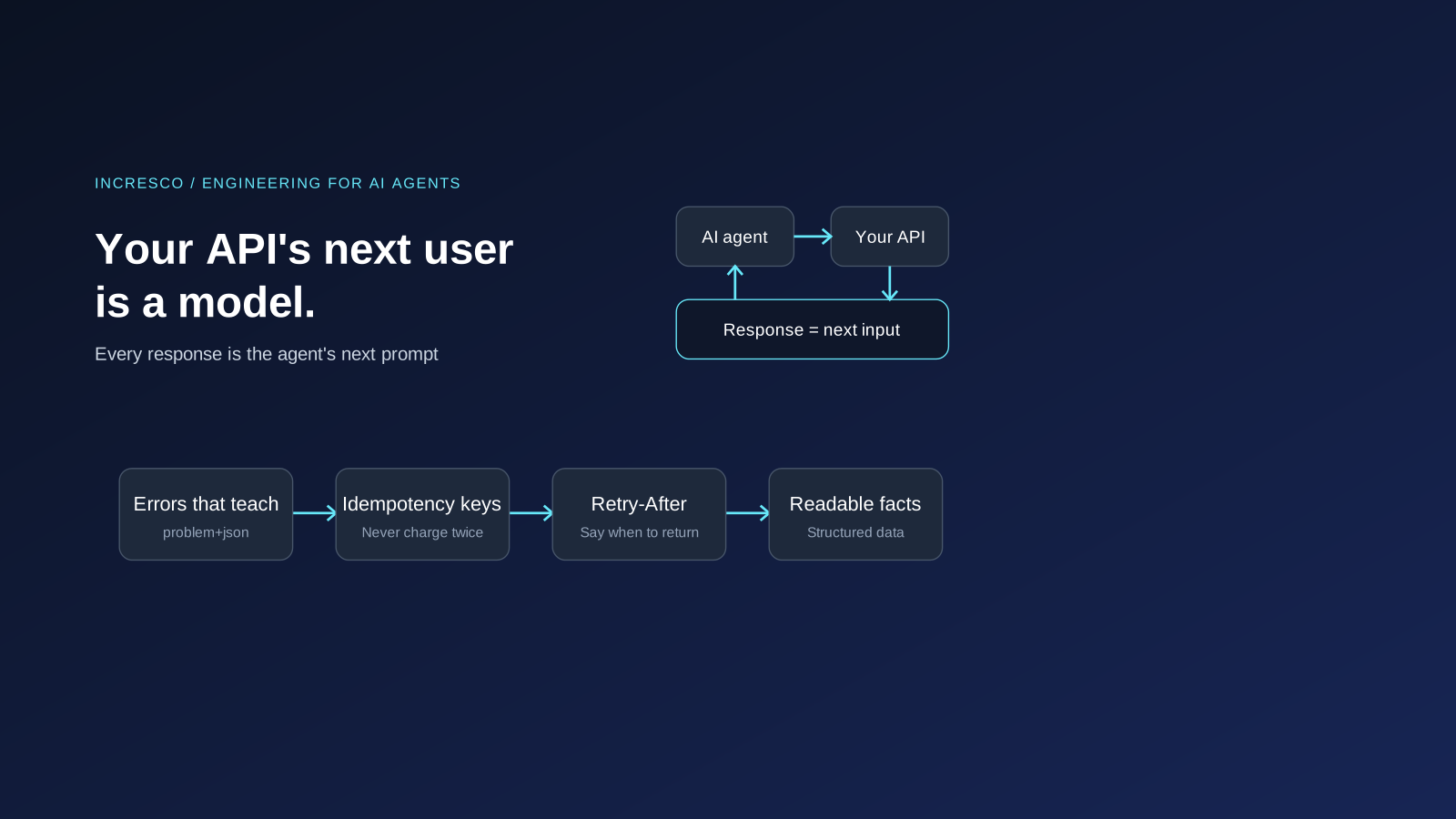
Your API's Next User Is a Model: Agent Experience (AX) for Engineers
AI agents call your API and treat each response as their next prompt. Engineering for them: clear errors, idempotency keys, rate limits and MCP tools.
Read Insight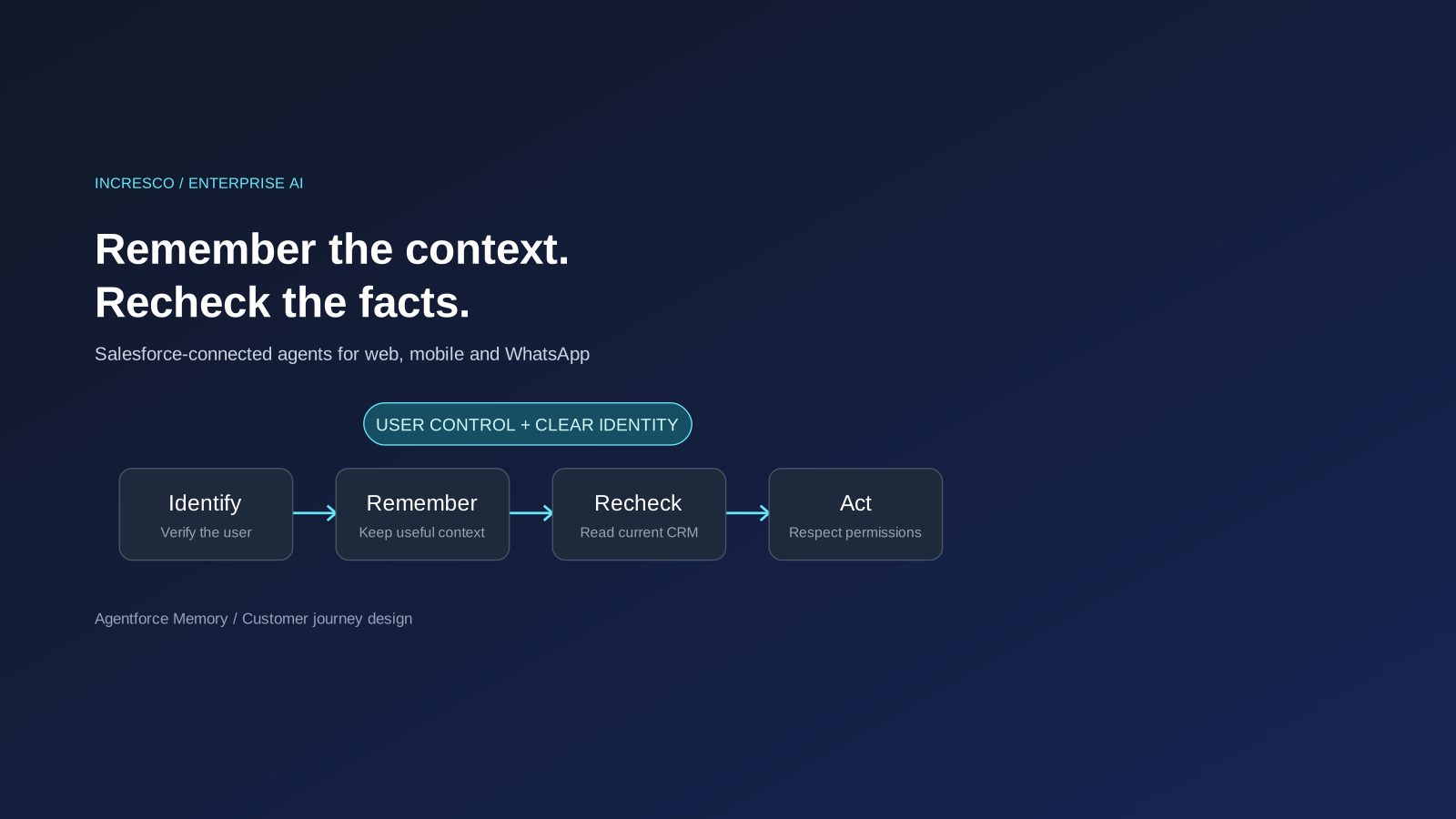
Business
Agentforce Memory: What Salesforce and WhatsApp AI Agents Should Remember
Salesforce's new Agentforce Memory engineering article explains persistent context. What should web, mobile and WhatsApp AI agents remember, refresh or forget?
Read Insight