
Blog Article
AI for Hotel Operations: Beyond Chatbots
AI for hotel operations goes beyond chatbots—connecting PMS, CRM and booking data into governed, context-aware guest service for European hotels.

The next wave of innovation in AI is not the AI tech itself, but the various use cases for AI in other industries. Just in the past couple of years, AI has moved leaps and bounds beyond just chatbots that managed simplified customer support. The potential for AI in meaningful contribution towards operations and decision-making is no more just theory; it is now a question of who will get the “First Mover Advantage” in implementing AI. It can draw data from all the different siloed systems, like CRM, Property Management System, Booking Engines, Customer Support system, all in one place and take meaningful contextual decisions and provide useful support to hotel operators while also being always available on demand as a concierge for the hotel guest, which lives in their phone.
Even for the leading European hotel operators, this is fundamentally a question of governance since guest data moves between different systems and the AI layer. Such an implementation needs proper planning, data processing responsibilities, access controls, retention rules, and human oversight. The accuracy of the model is just one standard among many, but all these protocols must be addressed together.
This AI system opportunity is far bigger than a basic chatbot conversation on a website. Connected AI systems for luxury hospitality can improve the path from discovery to booking, preserve context during the stay, and reduce the manual work required to complete a guest request, making AI a transformative and well-taken hotel system integration rather than just plugging in a simple chatbot.
Connected hotel AI starts with guest context
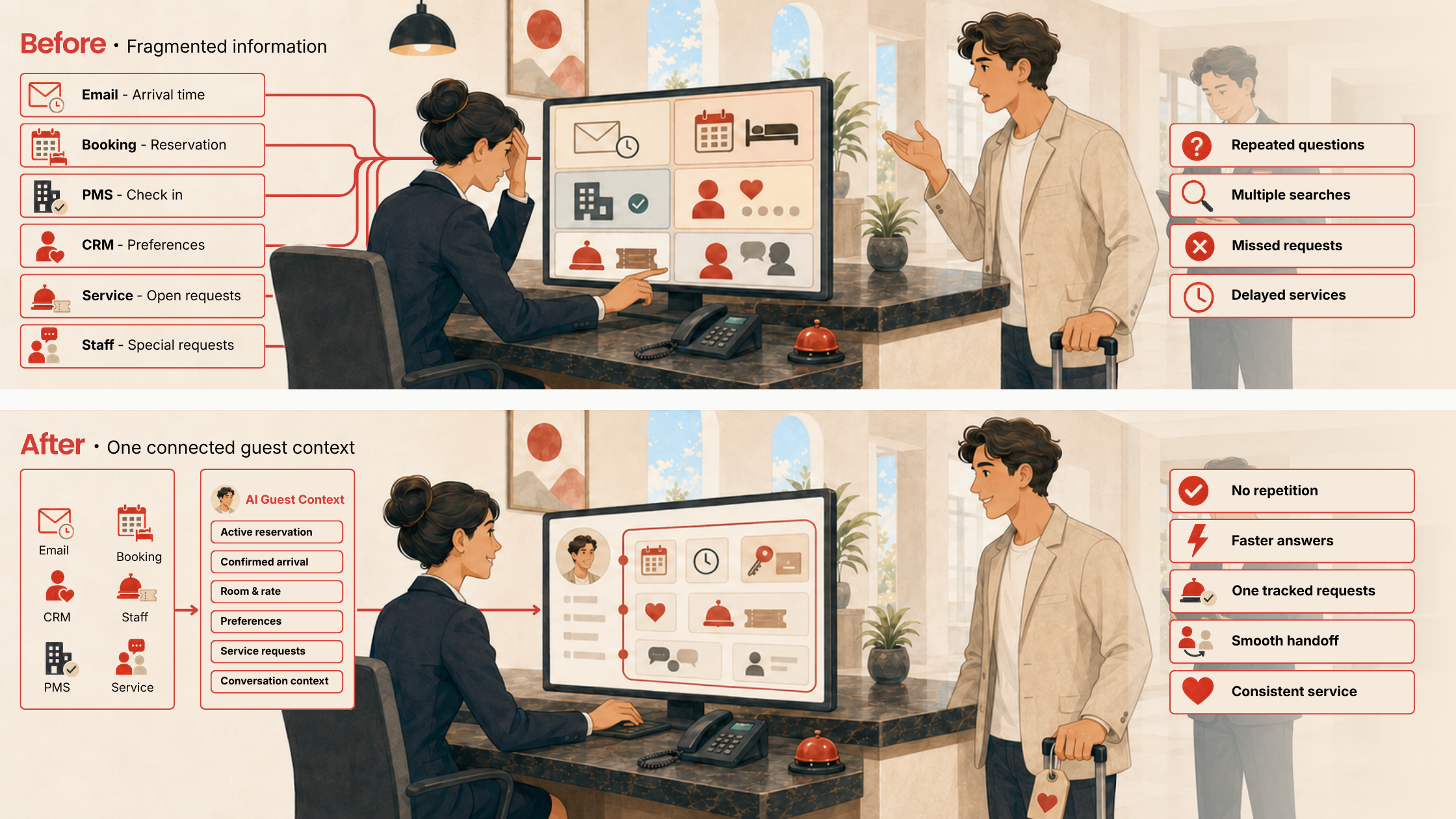
The guest barely notices the most useful working form of artificial intelligence in hospitality, what they notice is how they are going to benefit from the connected view of information the hotel already holds of them and how that data translates to enhancing their stay experience.
That information is usually scattered across property systems, booking engines, customer records, service tools and staff conversations. A guest may share an arrival time by email, ask about the room in an app, and repeat the same details at reception. Each contact may work on its own. The experience still feels disjointed.
AI can close those gaps when it has controlled access to accurate information and clear operating rules. It can retrieve a policy, recognize an active reservation, create a service request, and carry the conversation into a human handoff. The guest gets a useful answer. The hotel completes the work behind it.
Fluent answers are now easy to produce. Reliable service is harder. A hotel assistant must know which property it is discussing, which rates are available, what the guest has confirmed, and which employee should take over when the request exceeds the system’s authority.
This is primarily a systems problem. The AI layer becomes useful when it is integrating disconnected hotel systems and working from the same operational records as the staff.
Service continuity turns conversations into actions
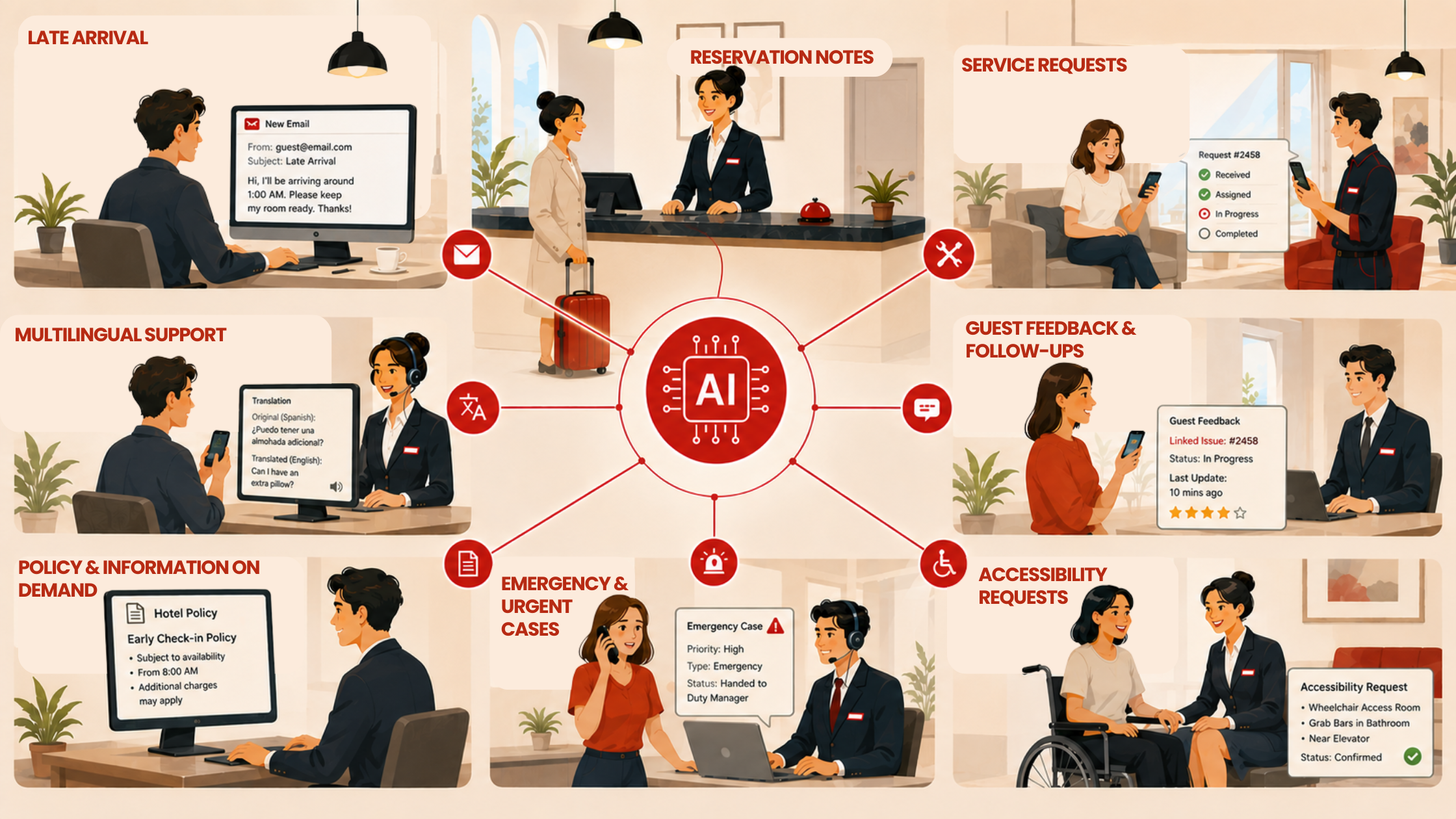
The guests would love to witness the seamless experience they receive in a hotel from what they have already said in their earlier stays. They rarely care about which PMS or CRM holds that information, but the connected data translating into action is what guests need
In your hotel, consider a traveller who emails a late arrival time. At reception, that detail should already be attached to the reservation. If the room is still being prepared, the next employee should see the earlier exchange and the status. The guest should not have to reconstruct the story at every step.
AI can summarise earlier conversations, translate a request, retrieve the relevant policy, and show an employee what has already been promised. The employee still makes the judgment. The system removes the search and repetition that slows the response.
When a guest asks for towels or reports a broken air conditioner, a confirmation message is only the starting point. The request must reach the right team, be assigned an owner and remain visible until it is completed. If the guest later mentions the same fault in an in-stay survey, the hotel should recognise that both reports describe one unresolved problem. That gives the property time to recover the stay before checkout. It also changes the measure of success. The useful metric is the share of guest needs completed correctly, and the time required to complete them. The conversation volume alone says little about operational value.
There are some specific in-hotel conversations that require immediate human attention. A question about checkout time can be answered at any time, but a message on emergency, personal safety, or a disputed payment should immediately move to an employee. The conversation history should move with it. A handoff that forces the guest to start again has failed.
Similarly, the implementation of multilingual service also needs the same level of discipline. Translation can reduce response time, but the original request, translated meaning, action taken, and responsible employee should remain visible. Accessibility requests need a clear route to a person who can confirm what the property can deliver. This protects the guest and improves the AI guest experience because the system supports a completed service outcome rather than a fluent but uncertain answer.
Direct booking is the clearest commercial opportunity
Even before the guest arrives, a better service can support the hotel’s revenue. Hotel websites produced an average booking value of $516 in 2025, according to SiteMinder’s Hotel Booking Trends. The average was $312 through online travel agencies, $392 through global distribution systems, and $445 through wholesalers.
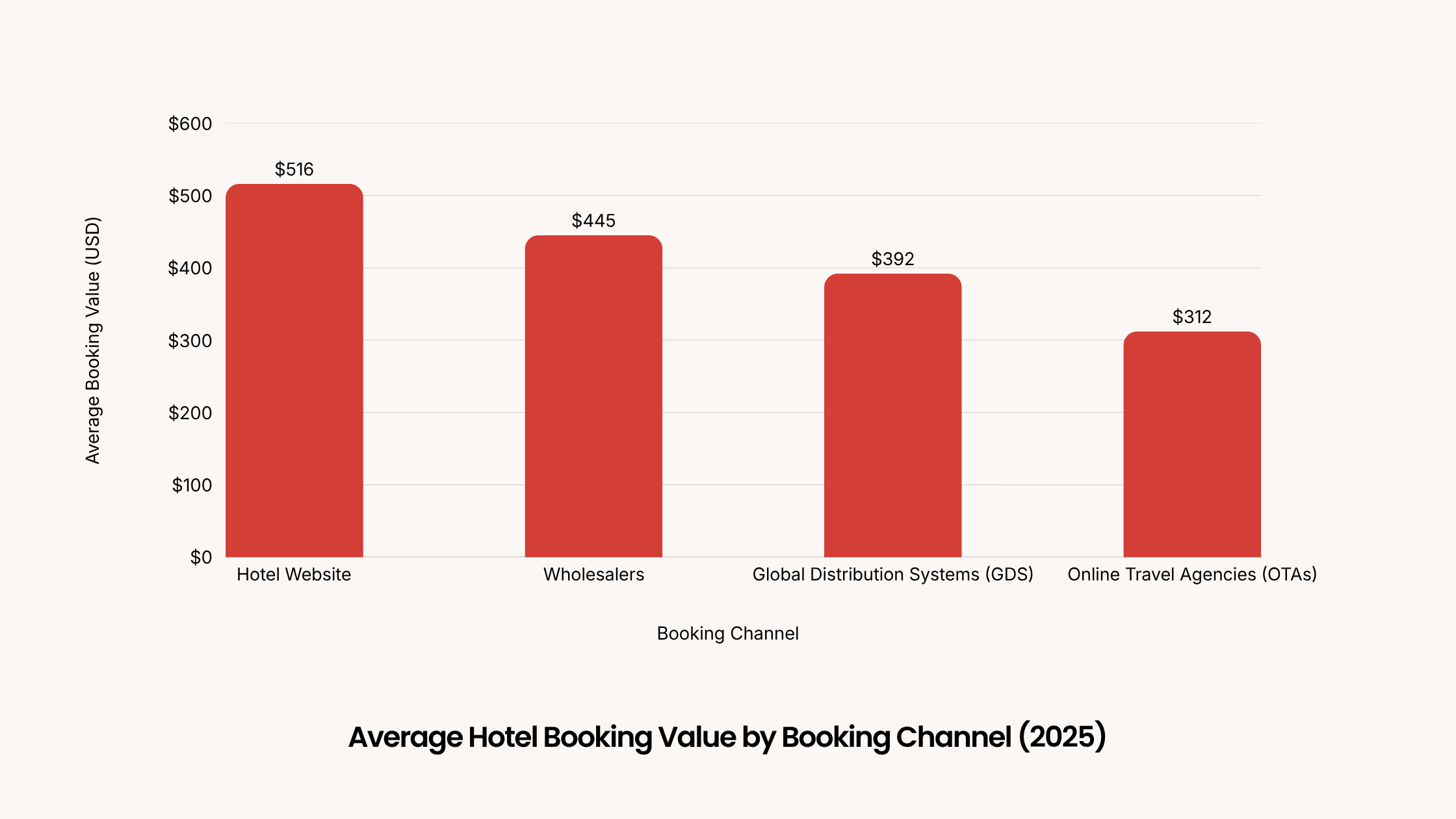
We notice the difference to be significant because a direct booking was worth $204 more than an average OTA booking. SiteMinder attributes the higher value to guests selecting higher-value rooms, staying longer and adding services.
A hotel-aware assistant can help a traveler move from a broad question to a bookable option. It can compare room types, explain a package, recognize a loyalty benefit, and present live availability. To do that, it needs current commercial data. A polished description has little value if the system cannot show an available room at the correct price.
An AI travel assistant connected to Salesforce and booking data shows this model in practice. The conversational layer handles discovery and qualifications. Structured guest intent flows into Salesforce. Booking data, availability, preferences, and programme details remain synchronized with operational workflows.
SiteMinder’s 2025 traveller research found that 52 percent of travellers had abandoned an online booking because of a bad digital experience, as summarised by UKHospitality.
Google classifies Largest Contentful Paint of 2.5 seconds or less as a good user experience. Hotels should test their own booking pages with Core Web Vitals rather than compare general page-load figures directly with LCP.
The commercial case starts with sound and AI-integrated digital operations that deliver the right service to guests. The prices must be set accurately. The website pages must perform well. The booking interface and flow must be clear. All these put together reduce the effort between a traveller’s question and a completed reservation.
What hotel AI integration requires across PMS, CRM, and booking systems
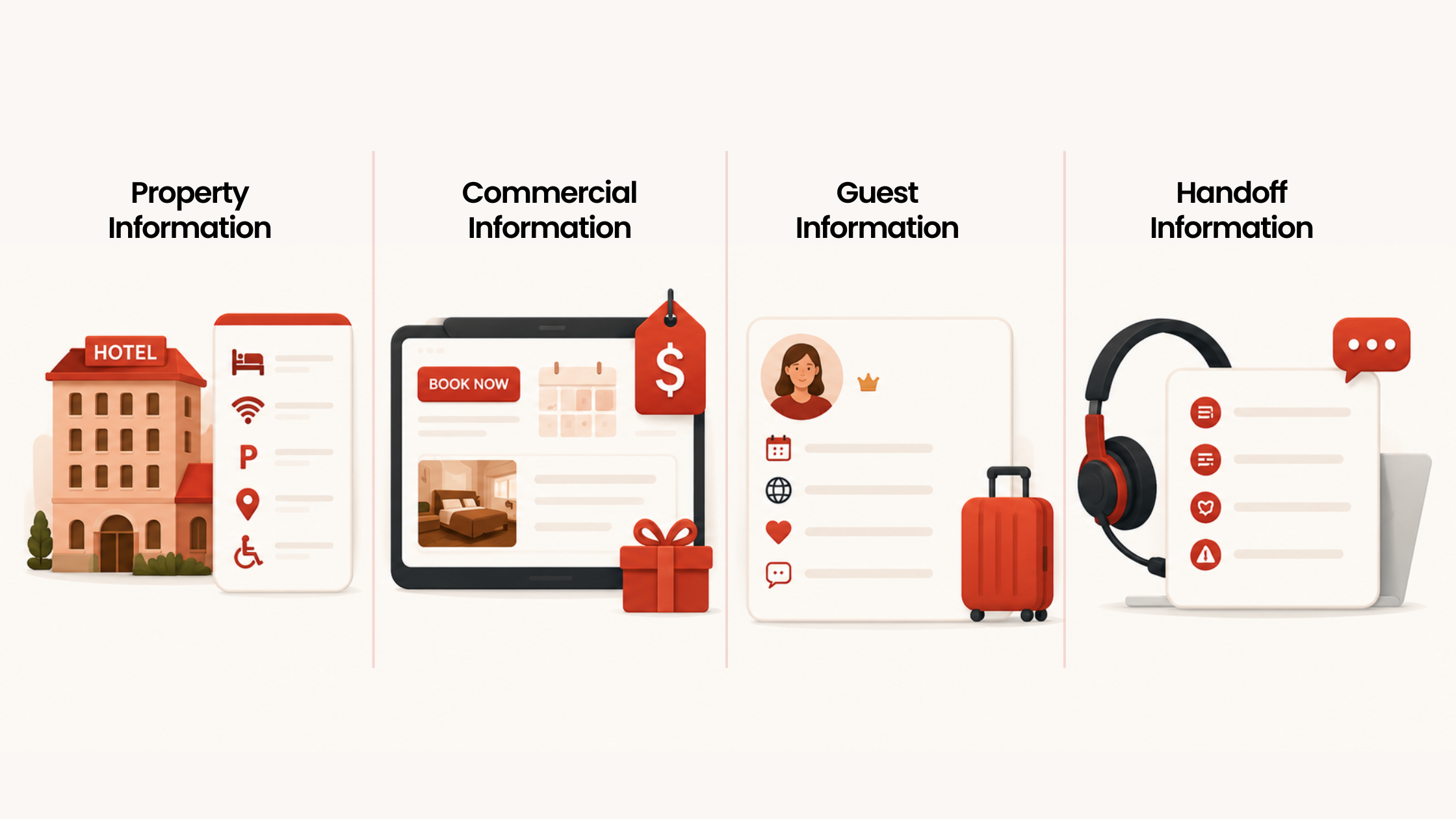
A useful hotel assistant draws from four kinds of information context that can translate into guest actions. Property information covers rooms, amenities, policies, parking, location and accessibility. Commercial information covers live rates, packages, loyalty benefits and availability. Guest information covers the current reservation, language, loyalty status, confirmed preferences and open complaints. Handoff information preserves the conversation, the steps already taken and the reason an employee needs to intervene.
These sources should remain distinct in their respective systems that can help AI to retrieve relevant information. Property details must stay specific to the property. Rates and availability must come from live systems. Guest information must be limited to what serves the current interaction. Handoff records must be concise enough for an employee to act quickly.
The AI layer does not replace the PMS, CRM or service tool. It fetches the information, performs an approved action and writes the outcome back to the system that owns the record. Hotel PMS integration should preserve the PMS as the source of truth for reservation and stay data. Hotel CRM integration should preserve consent, profile ownership and customer history inside the CRM.
That system design needs firm access boundaries before taking it live. The PMS remains the final authority when records conflict. Payments and account changes require authentication. Safety concerns may always go to an employee. High-cost gestures may need a manager’s approval. These rules turn a general model into a controlled operating layer for guest service.
There are some approved workflows that use agentic AI for hotel operations. An agentic system can retrieve data, choose from permitted tools and complete a defined action. Its authority must remain narrow. The same controls apply to personalisation. A preference the guest has stated can support a service action. An inferred pattern should be treated as a possibility.
If a returning guest has confirmed a dietary requirement, the hotel can send it to the kitchen before arrival. If the system notices two vegetarian orders, it may prompt an employee to ask about preferences. It should not record the guest as vegetarian or act as if the preference were confirmed.
This boundary allows hotels to anticipate needs without becoming intrusive. A confirmed accessibility request can trigger room assignment before check-in. An approaching arrival can trigger a relevant pre-arrival message. An open service issue can trigger a reminder to the responsible team. Each action begins with reliable data and a clear service purpose.
European hotel AI requires governance by design
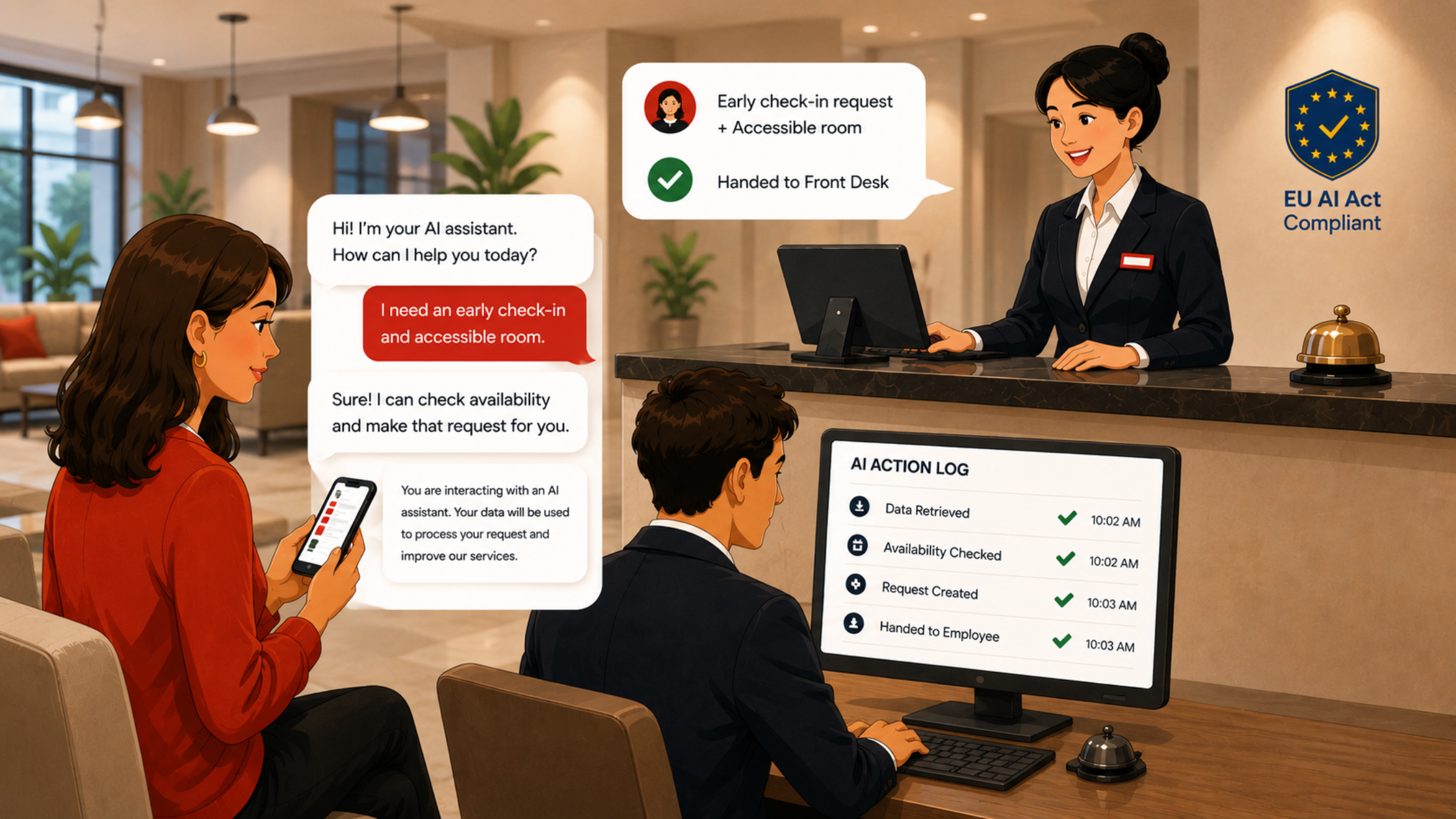
European hotel groups need to map how guest data moves across the full technology stack. The GDPR principles described by the European Data Protection Board require a lawful basis for processing, data minimisation, purpose limitation, storage controls and appropriate security. A hotel should know which organisation acts as controller or processor at every stage and which vendors can access personal data.
GDPR compliance for hotel AI should be translated into system requirements because The implementation needs documented data flows, role-based access, processing purposes, deletion rules, vendor responsibilities and evidence that the controls operate as designed.
The retention rules should follow the intention of each record for what it is curated for since a service request may need a different retention period from a loyalty profile or a payment record. The AI layer should not become a permanent copy of every conversation by default.
Similarly, international data transfers need an equal level of attention as the data regulations vary according to the laws of each country. A European hotel may use a model provider, cloud platform or messaging service outside the European Economic Area. The group should confirm where data is processed, which safeguards apply and whether onward transfers are permitted.
Access control must be set up properly and should reflect hotel roles. A front desk employee may need arrival details and open service issues. A revenue manager may need demand and booking signals. Neither role needs unrestricted access to every field in the guest profile. The model should receive only the information required for the approved task.
The design must have human oversight into the workflow, as guests need a clear route to an employee. Staff need to see the source information behind a recommendation. Managers need logs that show what the system retrieved, what action it attempted and whether the action was completed.
Visible AI also needs clear disclosure of what customer data the hotel operators are going to use. From 2 August 2026, Article 50 of the EU AI Act generally requires people to be informed when they are interacting directly with an AI system, unless the interaction is obvious. Incresco’s guide to EU AI Act compliance explains why disclosure, logging, and escalation should be treated as engineering requirements.
For a multi-property hotel with AI deployment, governance should be consistent while local operations remain specific. A shared policy can define access, retention, and escalation. Each property still needs accurate local content, current rates, service hours, accessibility information and country-specific operating rules.
The same pattern shall apply to cross-border rollouts and then the group can standardise identity controls, data contracts, audit logs, and model evaluation. Local teams should own property facts, operational authority, language quality and escalation routes. This lets one platform support several countries without flattening local operations.
Hotel discovery is becoming conversational
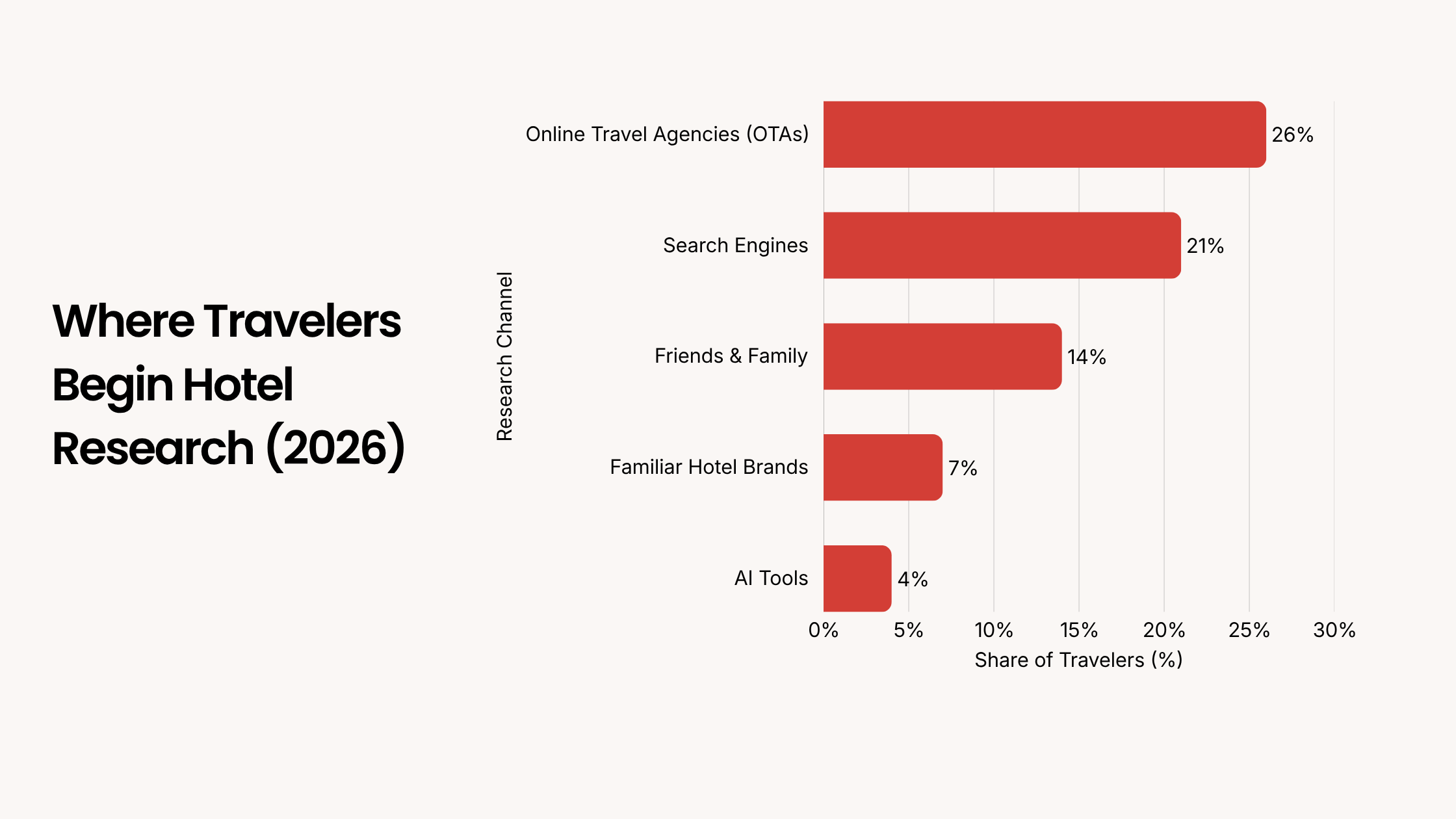
There is an evolution in the way guests have started to ask questions to hotels. They expect an action to be completed rather than just consuming information. SiteMinder’s Changing Traveller Report 2026 surveyed 12,000 travellers in 14 countries. OTAs were the most common starting point for hotel research at 26 percent. Search engines followed at 21 percent, friends and family at 14 percent, familiar hotel brands at 7 percent and AI tools at 4 percent.
Travellers are beginning to describe what they want in a conversation instead of selecting a destination, date, and room from a fixed sequence of filters. A guest may ask for a quiet hotel near a station with a late arrival, an accessible bathroom and a flexible cancellation policy. Answering that request requires reliable data from several systems at once.
Hotels need the same information foundation whether the conversation happens on their website, in their app or through an external AI service. The surface will change. The need for accurate property, commercial, and guest context will remain.
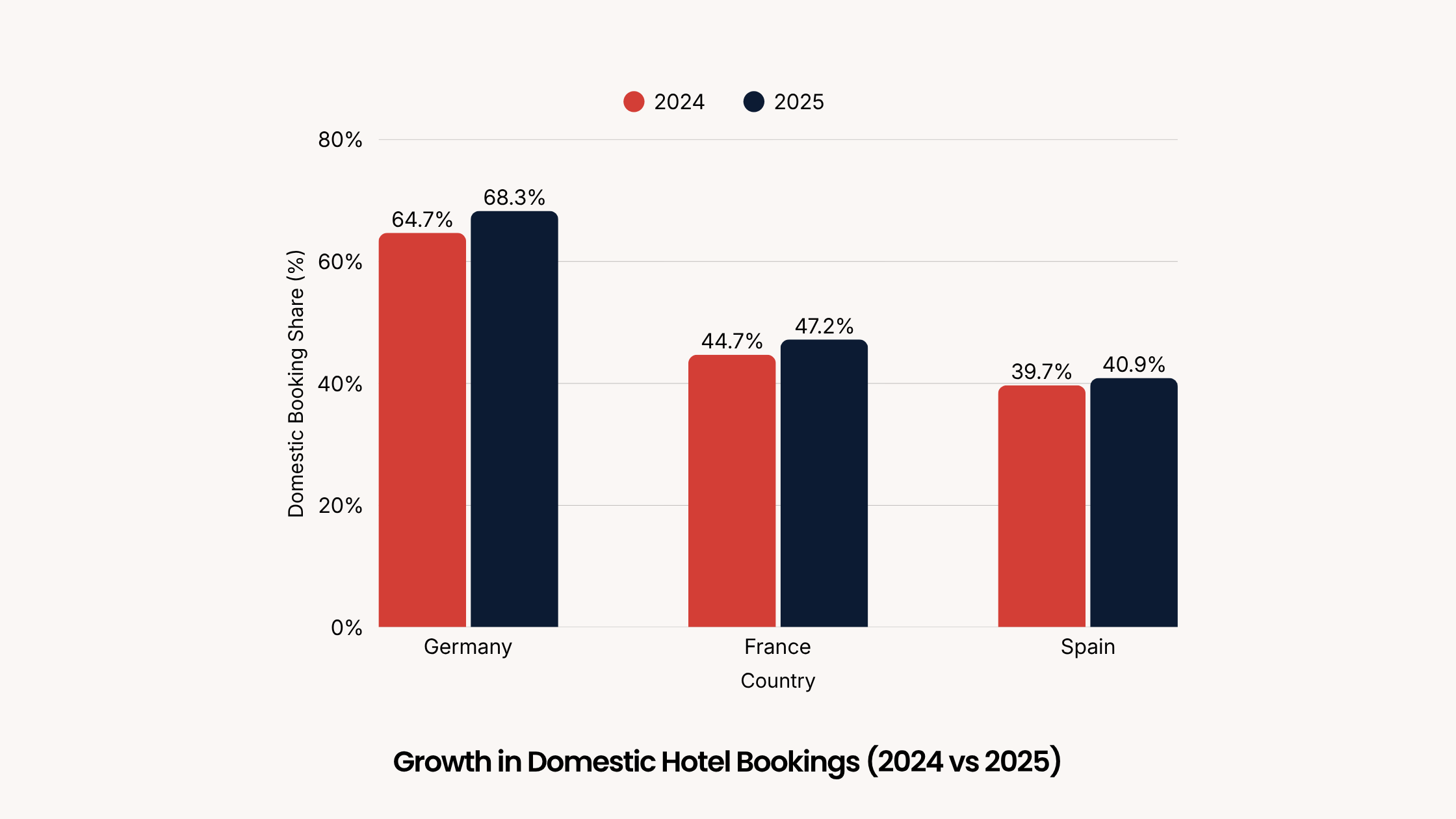
SiteMinder’s country data shows domestic bookings rose in 2025 from 64.7 to 68.3 per cent in Germany. They rose from 44.7 to 47.2 per cent in France and from 39.7 to 40.9 per cent in Spain. The path from OTA research to direct booking has also been strengthened. SiteMinder reported that 18 per cent of travellers who began on an OTA later booked directly, an increase of 3.3 percentage points in one year.
These transitional shifts make broader customer labels less useful because of the diversification of guest profiles. A domestic repeat visitor may need different information from an international first-time guest. The system should rely on the current trip,, reservation and stated needs instead of forcing each traveller into a fixed segment.
The need for guest context has become clearer at various destinations across Europe. The Vienna Tourist Board reported just over 20 million overnight stays in 2025, with international visitors accounting for around 83 per cent. isitBerlin reported 29.4 million overnight stays, with international guests accounting for 41 percent.
At that volume and language mix, service cannot depend on staff memory alone. The Hotel AI systems need to retrieve accurate information and preserve it across each interaction.
The conversational discovery also raises a content question that needs be addressed by hotel operators. Property descriptions, room attributes, policies, accessibility information and rate rules need structured ownership. The same records that support staff and booking engines will increasingly support AI assistants. Search visibility and service reliability will depend on the quality of that underlying data.
The next phase is controlled action
Hotel investment is moving towards the data needed to support this model. A 2025 study by h2c covered 171 hotel chains with more than 11,000 properties. Half of the chains selected customer data management as an area for future AI expansion. Fewer than one in ten surveyed chains reported a comprehensive company-wide AI strategy.
The returns depend on how the hotels execute these systems. A hotel should begin with a recurring point of guest effort that can be measured. Good candidates include repetitive pre-arrival questions, multilingual requests, check-in delays, lost service tasks and incomplete handoffs.
The first AI system deployment should have a visible operational result - any valuable metric and it should help improve revenue and enable a faster rate of service. Operators can track the time to a useful response, the rate of repeat contact, the success of human handoffs and the number of unresolved requests at checkout. Guest satisfaction after service recovery can show whether faster action also produced a better outcome.
Operators need to know which system owns each record, what data the model receives, which actions it can write back, how identity is verified and how failed actions are detected. They should also ask whether one property’s data can appear in another property’s response, how vendor access is controlled and what happens when a model or integration is unavailable.
Employees may use AI to retrieve a policy, translate a message or review the history of a complaint. Guests may experience a faster and better-informed human response without seeing the software that helped produce it.
The larger opportunity is a hotel that can carry context from discovery through departure. It can answer a booking question with live information, prepare for a confirmed need, route an in-stay request and give an employee the history required for recovery. The technology earns its place when the guest spends less time explaining and the hotel spends less time searching.
That is the benchmark operators should use when evaluating their hotel AI systems. The question is whether the system helps your property deliver accurate, timely and accountable service at scale.
Related Articles
Engineering
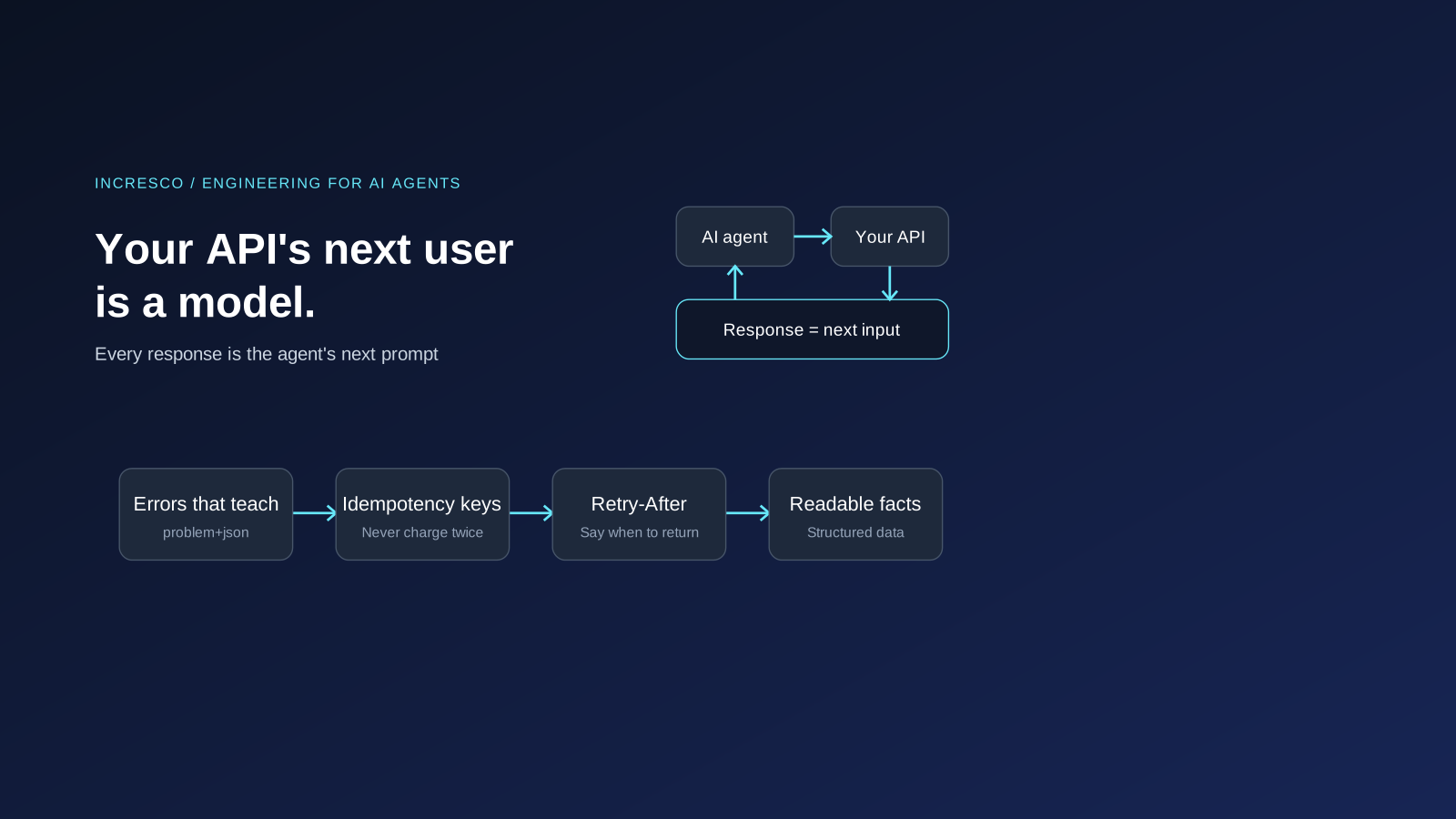
Your API's Next User Is a Model: Agent Experience (AX) for Engineers
AI agents call your API and treat each response as their next prompt. Engineering for them: clear errors, idempotency keys, rate limits and MCP tools.
Read Insight
Business
Agentforce Memory: What Salesforce and WhatsApp AI Agents Should Remember
Salesforce's new Agentforce Memory engineering article explains persistent context. What should web, mobile and WhatsApp AI agents remember, refresh or forget?
Read Insight