Blog Article
Muse Wonder for Business: What AI Agents Now Mean for Hotels, Property Managers and Universities in Europe
Muse Wonder scores 68% on business workflows. What that means for European hotel, property and university leaders: cost, memory, GDPR and system integration.

On 12 October 2026, Meta introduced Muse Wonder, a model family built for agentic work: tasks that run across several steps and several systems. Muse Wonder is available through the Meta Model API and Muse Code. The larger Muse Wonder Full is reserved for Muse Code subscribers. Both accept text, image, video and audio within a one-million-token context window, and both produce text. Meta positions the family around two capabilities, Active Memory and Active Focus, designed to keep an agent on the relevant detail across long working sessions.
Artificial Analysis, an independent benchmarking firm, reports that Muse Wonder completes 68% of tasks on AutomationBench-AA, its business-workflow test. For hotel, property and education leaders in Europe, that moves agents out of demonstration territory and into operational questions. Those questions are not about the model. When an agent says the booking has changed or the record is updated, someone must still prove it. That proof lives in connected systems, current records and checks on the end state, not in a confident reply.
This article covers how Muse Wonder handles changed facts, what the 68% score means, what agents already do in Germany, Austria and Switzerland (DACH), what it takes to connect the model to your systems, what a workflow costs, and what to check before customer data is involved.
How Does Muse Wonder Handle Memory When Facts Change?
Consider a guest who messages your hotel several times a season: a standard room, an upgrade, a date change, a rebooking at a new rate. Elsewhere, a tenant adds a parking space and agrees to a rent adjustment, and a student moves part-time study and swaps two modules. Each eventually asks the question that matters: what am I paying, what do I owe, what am I enrolled in?
Meta built MemoryBench to test exactly that moment. It places distractions, contradictions, and updated facts inside a long conversation, then checks whether the model still acts on the current truth. It is Meta’s own test, judged by another model, so it should be treated as evidence rather than proof. It does, however, test the right thing.
For a business, that difference is money. An agent that remembers everything but acts on an outdated rate will quote the wrong price with complete confidence. An agent that starts from the current record gets the price, the payment date, and the term right. Remembering was never the hard part. Acting on the newest fact when it counts is.
What Does Wonder’s Score Mean for Your Business?
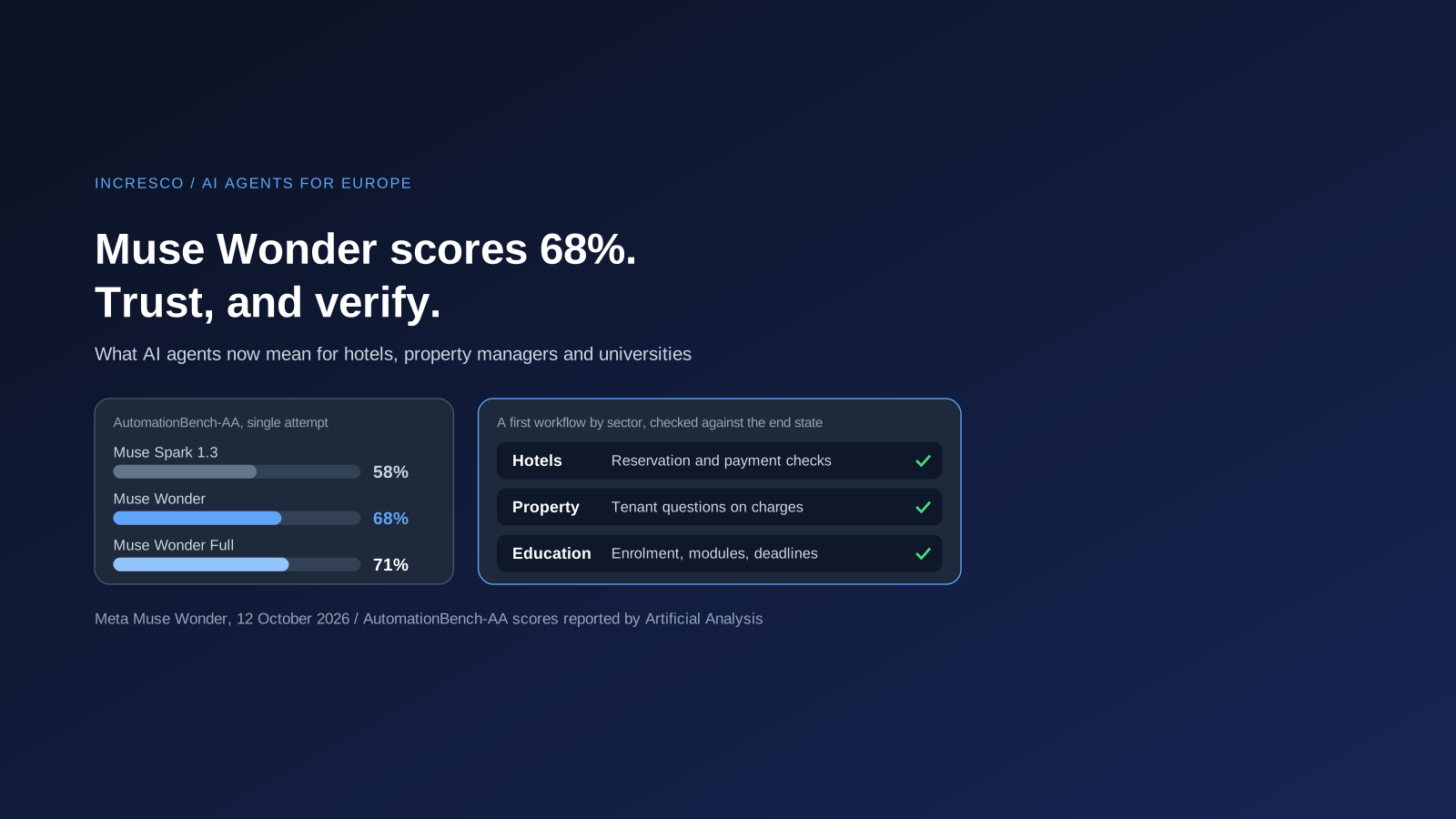
The headline figure is 68%. That is Muse Wonder’s score on AutomationBench-AA, measured independently by Artificial Analysis rather than by Meta. Muse Wonder Full scores 71%, and Meta’s previous model, Muse Spark 1.3, scored 58%. The family is moving quickly in the right direction.
The design of the test matters more than the number. As we read the methodology, the agent is graded on the state of the system when it finishes (did the booking actually change, is the record actually right) rather than on whether its reply sounded convincing, and it receives a single attempt.
Read 68% as an operator would: not as “three bookings in ten will go wrong”, but as “trust, and verify”. A fluent paragraph from an agent is a report to read, not a decision made. The proof is the record it leaves behind. A hotel that lets an agent change reservation, a property manager that lets one adjust charges, and a university that lets one update enrolment each need the same habit: check the end state.
Where Are AI Agents Already Working in Germany, Austria and Switzerland?
Agents are already at work across DACH, in the following roles.
- Property, Austria: Flatwise completed a six-month pilot covering 200 users and more than 3,000 managed homes, in which an agent handles vacancy, yield and maintenance questions that teams would otherwise answer by phone.
- Education, Germany: Saarland University students can add three study agents (a writing assistant, a learning coach and a maths tutor) from the university’s own store.
- Hospitality, Switzerland: hotel-technology firm Aphy runs four back-office workflows: reservation checks, payment checks, commission reconciliation and email.
Most of these deployments share a shape: narrow, frequent questions whose answers already live in a system of record. That is the shape we build at Incresco. Agents on Salesforce and WhatsApp answer from the live record and hand over to a person when the record is not enough. When choosing a first workflow, apply the DACH lesson. Choose the question your team answers fifty times a week, where the answer sits in one system, and the result can be verified.
A first workflow by sector
- Hotels: reservation and payment checks, and guest messages about changes to bookings.
- Property: tenant questions on charges, vacancies and maintenance status.
- Education: student questions on enrolment, modules and deadlines.
What Does It Take to Connect Muse Wonder to Your Business Systems?
Muse Wonder arrives with a million-token context window and a 68% workflow score. It does not arrive connected to your property management system (PMS), your ledger or your student records. The model is the easier part. The work is the wiring, which is why system integration starts before anyone writes a prompt: map what your business tracks, what it decides, and where work passes between people.
A hotel agent needs live rates and availability from the PMS, plus permission to change a booking, not merely to talk about one. A property agent needs the ledger and the maintenance system, with clear limits on what it may adjust. A university agent needs enrolment records and a hard rule about which changes to wait for a person. Every connection has two decisions: what the agent can read, and what it can write.
The model and the channel are separate choices. Meta supplies the model through its API; a channel such as WhatsApp Business and access to your own systems are what you or your integration partner build around it. If a vendor demonstration never covers this, the demonstration is doing all the work.
What Does a Muse Wonder Workflow Cost?
Muse Wonder is priced at $4 per million input tokens and $20 per million output tokens, with cached input at $0.20 per million. On Artificial Analysis’s own test, its average cost was $4.52 per Intelligence Index task, against $1.60 for Spark 1.3, almost three times as much. The driver is mostly input: the model reads a great deal of context, and input accounts for roughly three-quarters of that cost. That is a design lesson. How much context an agent carries, and how much of it can be cached, shapes the bill more than the length of its answers.
The $4.52 figure comes from a controlled benchmark, not from your operations. Your production task is a guest who rambles, a tenant who sends three photos of a leak, and a student who changes their mind twice, all of which consume context. The honest budget therefore has two lines. Tokens are the line you can see. The workflow is the line that decides integration, monitoring, the human spot-checks that a 68% technology still earns, and governance of customer data. At Incresco, we measure builds as we advise clients to cost per completed outcome, not cost per token. A cheap model that leaves wrong records is the most expensive option on the table.
What Should You Check Before Customer Data Is Involved?
Hotels, landlords and universities hold personal data about guests, tenants and students. Before an agent touches it, confirm the following with your data-protection officer or counsel.
- Roles and contracts: Who is the processor, and is a data-processing agreement in place (GDPR/DSGVO; in Switzerland, the revised Federal Act on Data Protection) Incresco publishes its own data-processing agreement for review.
- Location and retention: Where is data processed, how long are prompts and logs kept, and are any of them used for training?
- Transparency: People should be told they are dealing with an AI agent. Check the current EU AI Act timetable for chatbot transparency duties.
- Limit actions: Define which changes an agent may make alone, and which need human approval, particularly anything affecting charges, contracts or enrolment.
- Audit trail: Keep a record of what the agent read, what it wrote, and who approved it.
You Come to Us. We Identify, We Build, We Deliver
When you work with Incresco, we start by identifying the problem: we map your systems and find the workflow where an agent pays for itself, which is the focus of our AI transformation work. We then build the solution: an agent on Salesforce and WhatsApp, connected to the records that hold your truth, checked against the record it leaves behind, with access controls, monitoring and human review from the start. Finally, we deliver a working agent that your team uses, measured on completed outcomes rather than demonstrations.
Muse Wonder has raised what agents can attempt. Our task is to make sure yours can be trusted with it. To discuss the first workflow, book a call with the Incresco team.
Frequently Asked Questions
What Is Muse Wonder?
Muse Wonder is a model family from Meta, released on 12 October 2026 for agentic work. It has a one-million-token context window and two trained behaviours, Active Memory and Active Focus.
How Much Does Muse Wonder Cost?
The Meta Model API lists $4 per million input tokens, $0.20 for cached input and $20 per million output tokens. Artificial Analysis measured $4.52 per Intelligence Index task. Costs in your own workflow will differ.
Can a Hotel, Property Manager or University Use an AI Agent With Personal Data Under GDPR?
It can, provided the legal basis, processor contracts, data location, retention and human-approval limits are settled first.
What Should a First AI Agent Workflow Be?
A frequent, narrow question that your team answers dozens of times a week, where the answer sits in one system and the result can be checked.
Related Articles
Business
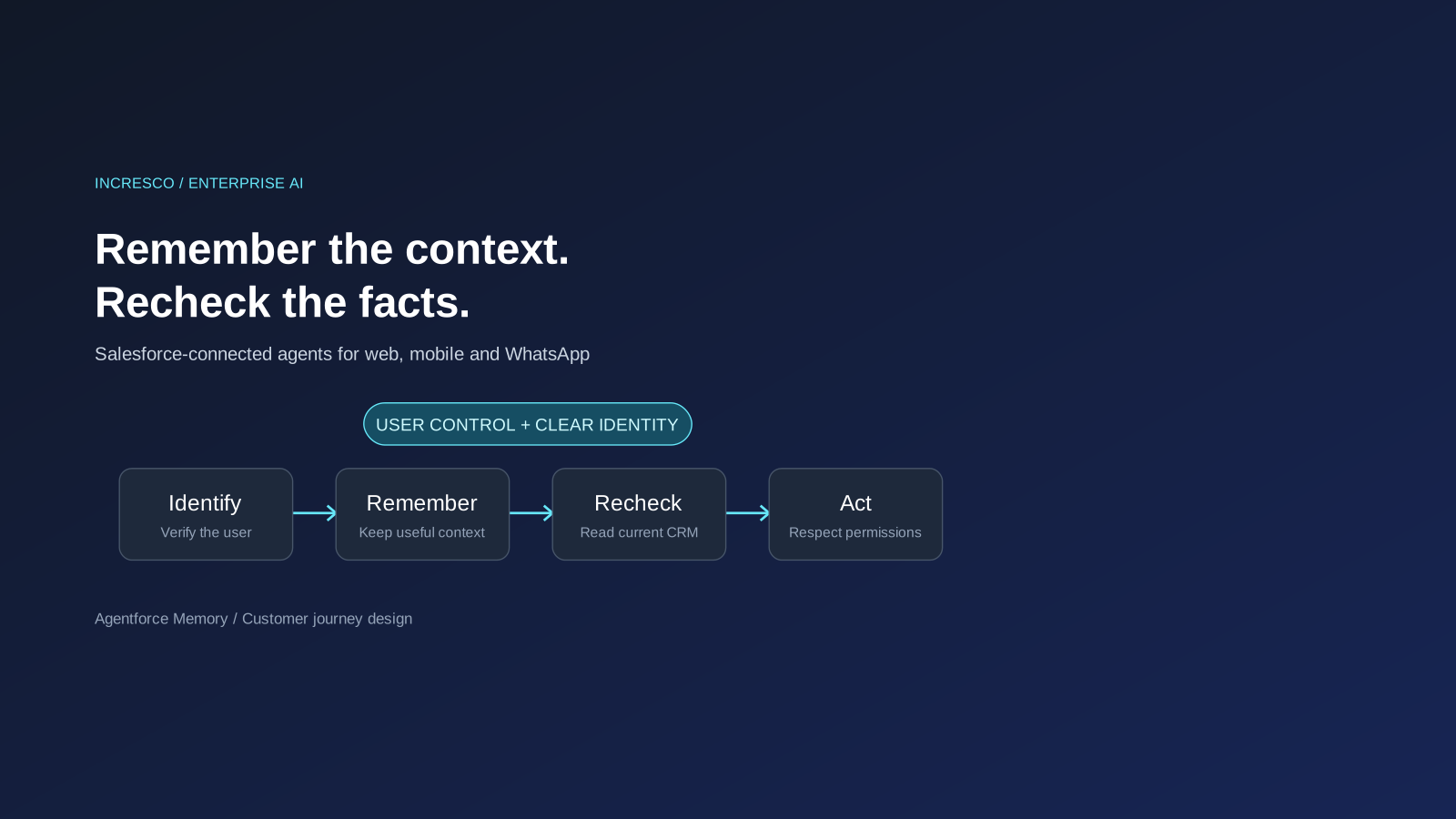
Agentforce Memory: What Salesforce and WhatsApp AI Agents Should Remember
Salesforce's new Agentforce Memory engineering article explains persistent context. What should web, mobile and WhatsApp AI agents remember, refresh or forget?
Read Insight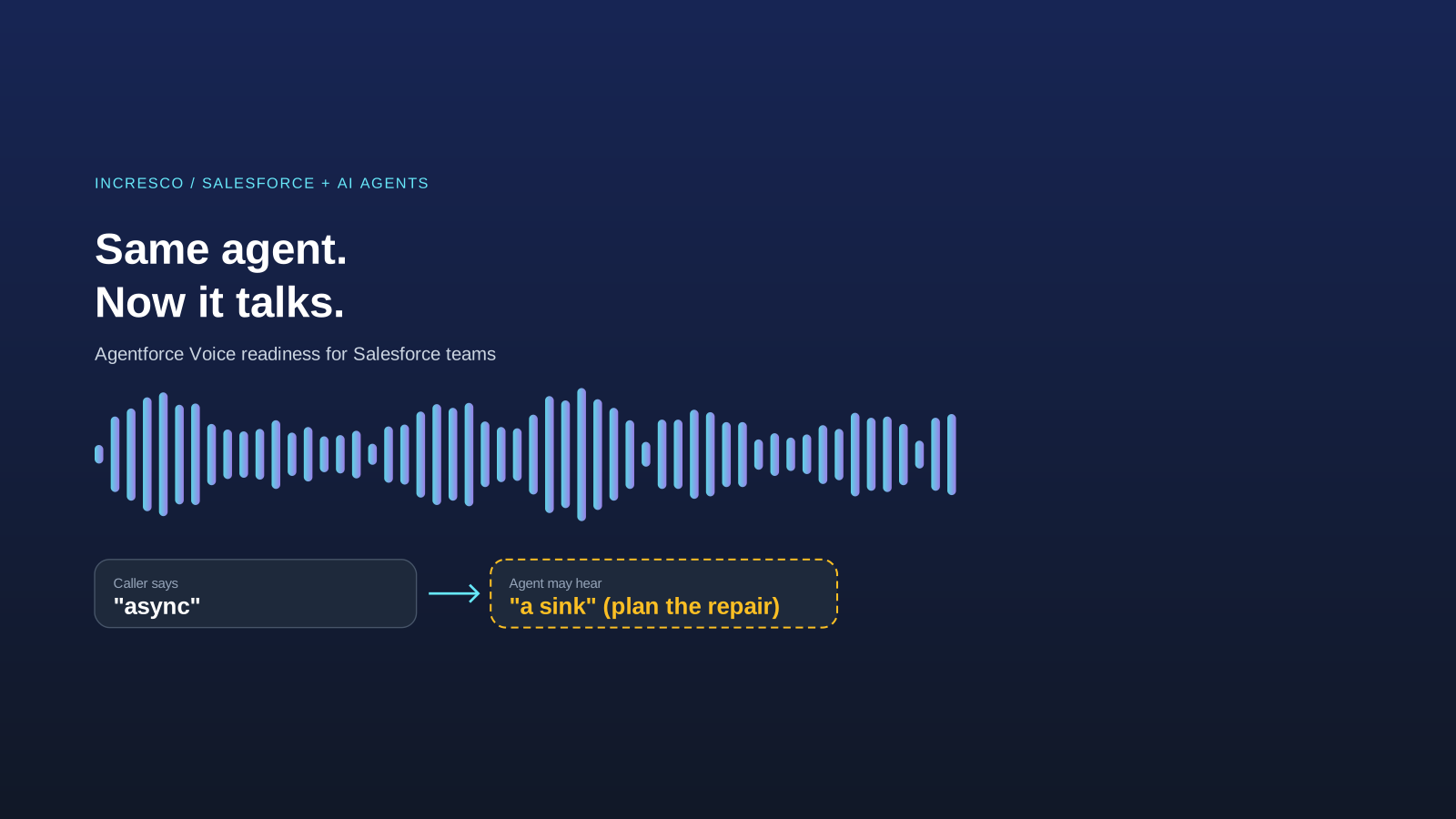
Engineering
Agentforce Voice for Agent Script: What to Check Before Your Salesforce Agent Starts Talking
Salesforce says you can add voice to an Agent Script agent without a rewrite. See what your org needs first and how to write agent instructions for the ear.
Read Insight