
Blog Article
From AI Assistant to AI Engineer: How Agentic Coding Changes the SDLC
Discover how AI coding agents are transforming the SDLC, from requirements and development to testing, deployment, and engineering roles.

For years, AI in software development largely meant assistance.
A developer could ask an AI coding assistant to complete a function, explain an unfamiliar piece of code, generate a unit test, or suggest a fix for an error. The developer remained at the center of the process, deciding what to build, writing the code, running the tests, and making the final decisions.
That model is changing.
In 2026, AI coding agents are moving beyond autocomplete and individual code suggestions. Modern agents can increasingly inspect repositories, modify multiple files, execute development tools, run tests, interpret failures, and iterate on their work. Anthropic’s 2026 research, based on a privacy-preserving analysis of roughly 400,000 Claude Code sessions between October 2025 and April 2026, found that people typically make most of the planning decisions while the agent handles more of the execution decisions.
This represents a shift from using AI primarily as an assistant to working with AI as an active participant in the software engineering workflow.
The result is an emerging approach often described as agentic coding.
From AI Assistant to Coding Agent
The difference between AI-assisted development and agentic software development is not simply how much code an AI can generate.
It is about how much of the development workflow the system can participate in.
A traditional AI coding assistant works roughly like this:
Developer → Prompt → AI Suggestion → Developer Review → Implementation
The developer drives every step.
An AI coding agent can work differently:
Goal → Plan → Inspect → Implement → Test → Observe → Iterate → Review
Instead of asking an agent to write a single function, an engineer can give it a broader objective, for example, adding authentication to an existing application, updating relevant database models, writing tests, running the test suite, and preparing the changes for review.
The agent can then work across the repository and development environment to complete multiple steps.
Anthropic’s 2026 analysis of approximately 400,000 Claude Code sessions found a recurring division of labor: people generally make more of the planning decisions, what should be done, while the agent handles more of the execution decisions, how to carry it out.
The distinction is important.
The engineer increasingly defines the intent, constraints, and acceptance criteria, while the agent can take responsibility for a larger portion of the implementation loop.
What Makes Coding Agentic?
An AI coding agent generally combines several capabilities:
- A large language model for reasoning and code generation
- Context from the project and codebase
- Access to development tools
- File and repository operations
- Terminal or command execution
- Testing and validation
- Feedback from the development environment
- The ability to iterate based on results
The most important part is the feedback loop.
Plan → Act → Observe → Evaluate → Act again
A conventional AI assistant may generate a solution and wait for another prompt.
An agent can potentially execute the solution, observe what happens, and use that information to determine its next action.
This changes AI from a system that primarily suggests into a system that can increasingly participate in execution.
But greater autonomy does not guarantee correctness.
An agent can execute many steps independently while still making incorrect assumptions about requirements, architecture, security, or business behavior. That is why agentic development makes feedback and verification increasingly important.
How Agentic Coding Changes the SDLC
The Software Development Life Cycle has traditionally been described through stages such as:
Requirements → Design → Development → Testing → Deployment → Maintenance
Agentic coding does not necessarily remove these stages.
Instead, it changes how work is performed within them and how responsibilities are distributed between humans and AI agents.
1. Requirements and Planning
Consider a simple requirement:
“Users should be able to reset their passwords.”
Traditionally, an engineer interprets the requirement and manually turns it into technical tasks.
An AI agent can help structure the requirement into:
Requirement → Acceptance Criteria → Technical Tasks → Implementation Plan → Test Scenarios
It might identify the need for:
- Password-reset APIs
- Token generation
- Token expiration rules
- Email delivery
- Database changes
- Frontend updates
- Security tests
- Error-handling scenarios
However, there is an important boundary.
AI can help structure and analyze requirements. It cannot automatically determine whether the underlying business requirement is correct.
That remains a product and engineering decision.
In an agentic workflow, this distinction becomes even more important because ambiguity can propagate quickly. An unclear requirement can lead to incorrect tasks, code, tests, and documentation before the problem is discovered.
The quality of the initial intent therefore becomes a critical input to the entire workflow.
2. Architecture and Design
Modern AI coding agents can work with considerably more context than a single code snippet.
They can inspect:
- Repository structures
- APIs
- Database schemas
- Dependencies
- Documentation
- Configuration
- Existing tests
- Infrastructure definitions
This allows an agent to investigate the potential impact of a feature across a system.
For example, adding multi-tenant support could affect:
Authentication → Database → APIs → Business Logic → Frontend → Testing → Deployment
An agent can investigate these dependencies and propose an implementation approach.
But proposing architecture and owning an architecture are different things.
Engineers still need to decide:
- Which design fits the existing system?
- Which constraints matter?
- Where should security boundaries exist?
- What trade-offs are acceptable?
- What technical debt can be tolerated?
- Which changes require additional review?
In an agentic SDLC, architectural judgment does not disappear.
Instead, it can become more important because engineers may be responsible for evaluating a larger number of agent-generated implementation paths.
3. Development
This is where the difference becomes most visible.
Traditional AI-assisted development often looks like:
Human writes → AI suggests → Human edits → Human runs
Agentic coding can look more like:
Human defines goal → Agent investigates → Agent plans → Agent modifies files → Agent executes commands → Agent evaluates results
The engineer moves from manually performing every implementation step toward directing and supervising a larger engineering workflow.
This does not mean engineers stop coding.
Rather, the balance of work can change.
Routine implementation, refactoring, test generation, documentation, and debugging may increasingly be delegated to agents, while engineers spend more time on system design, requirements, constraints, trade-offs, and verification.
Anthropic’s 2026 research provides evidence for this type of division of labor in actual Claude Code usage, although the findings should not be interpreted as proof that every engineering organization is already operating this way.
4. Testing and Debugging
This may be one of the most important changes.
Suppose an agent generates hundreds of lines of code in a short period.
The question is no longer simply:
“How quickly can we generate code?”
It becomes:
“How quickly can we prove that the code works?”
A traditional workflow might look like:
Write Code → Write Tests → Run Tests → Find Failure → Fix Manually
An agentic workflow can become:
Write Code → Generate Tests → Run Tests → Observe Failure → Investigate → Modify → Test Again
This creates a continuous engineering feedback loop.
And it highlights an important principle:
As code generation becomes faster, verification becomes more valuable.
Automated testing, static analysis, security scanning, integration testing, code review, and deployment gates therefore become increasingly important.
The goal is not simply to increase the amount of code an organization can produce.
The goal is to increase the amount of verified, maintainable, and production-ready software it can deliver.
5. Code Review and Deployment
More autonomous coding also changes the nature of code review.
When agents can produce changes faster, reviewing every line in exactly the same way may become difficult to scale.
Engineers increasingly need to ask:
- Does this implementation satisfy the requirement?
- Does it fit the existing architecture?
- Are the tests meaningful?
- What assumptions did the agent make?
- Did it introduce security risks?
- Is the implementation unnecessarily complex?
- Can the behavior be verified?
- What evidence supports the change?
The focus shifts from simply reviewing what changed toward understanding whether the change is correct, safe, and appropriate for the system.
The same principle applies to deployment.
An agent can potentially implement features, run tests, prepare deployment artifacts, analyze failures, and assist with release workflows.
But production systems introduce higher consequences.
For that reason, production environments still require appropriate:
- Approval gates
- Permissions
- Monitoring
- Auditability
- Rollback mechanisms
- Security controls
The more autonomous the workflow becomes, the more important it is to clearly define where autonomy ends and accountable human decision-making begins.
The Engineer’s Role Is Changing
Does agentic coding mean developers disappear?
That is too simplistic.
A more useful way to understand the change is through the distribution of work.
Earlier
Engineer:
Understand → Design → Code → Test → Debug → Deploy
Increasingly, in agentic workflows
Engineer:
Define Intent → Set Constraints → Design Architecture → Direct Agents → Verify Results → Make Decisions
AI Agent:
Explore → Implement → Test → Debug → Refactor → Document → Iterate
The engineer’s role is therefore not disappearing.
Instead, in agentic workflows, engineers can increasingly spend more of their time on higher-level decisions while delegating portions of execution to AI agents.
This creates a new set of valuable skills:
- System design
- Task decomposition
- Context engineering
- AI orchestration
- Security
- Verification
- Requirements engineering
- Evaluation of AI-generated solutions
- Understanding system-level trade-offs
The engineer becomes responsible not only for writing software, but also for designing the environment in which humans and AI work together to build software.
The New Risk: Moving Faster Than You Can Verify
There is a natural temptation to measure agentic coding by the amount of code produced or the number of tasks completed.
But more code does not automatically mean more valuable software.
If an agent can modify 50 files in minutes while the engineering team still has the same review and verification capacity, the bottleneck has simply moved.
Software delivery still depends on:
Code Review → Testing → Security → Integration → Deployment → Operations
This creates a new engineering problem:
Execution speed can increase faster than an organization’s ability to verify the results.
That is why organizations adopting AI coding agents need to rethink the surrounding engineering process as well.
McKinsey’s 2026 research on agentic product development identified four recurring themes among organizations reporting stronger results from AI-driven development:
- Redesigning end-to-end workflows
- Redesigning roles and responsibilities around human judgment and product intent
- Building verification, control, and measurement mechanisms that can keep pace with faster work
- Investing in upskilling and organizational change
The broader lesson is that adopting an agent is not simply a tooling decision.
It can require changes to the engineering operating model.
Autonomy Requires Guardrails
Agentic coding introduces a useful principle:
Autonomy should be proportional to risk.
Low-risk activities can often be highly automated.
Examples include:
- Generating documentation
- Creating unit-test scaffolding
- Formatting code
- Performing repetitive refactoring
- Investigating straightforward test failures
Higher-risk activities may require stronger controls.
Examples include:
- Authentication changes
- Authorization logic
- Payment systems
- Security-sensitive code
- Database migrations
- Infrastructure changes
- Production deployments
- Changes involving regulated or sensitive data
The goal is therefore not to maximize autonomous activity.
It is to build a development system where autonomy is:
Used where it is useful → Constrained where it is risky → Verified where correctness matters
The Agentic SDLC
The emerging model can be summarized as:
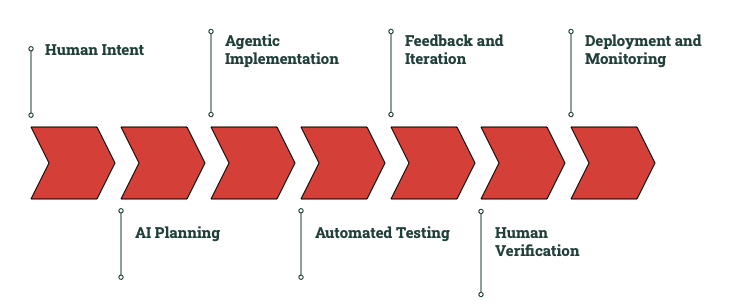
This is not a replacement for the SDLC.
It is an evolution of how work moves through it.
The stages remain familiar.
What changes is:
- Who performs each task
- How quickly the stages interact
- How much execution can be delegated
- Where verification happens
- How humans interact with the workflow
- How much autonomy is appropriate for each type of change
The SDLC becomes less about a sequence of manual handoffs and more about a continuous feedback system between human intent, AI execution, automated verification, and human judgment.
The Future of Software Engineering
The most important change brought by AI coding agents is not simply that they can generate code faster.
It is that they can increasingly participate in the engineering loop around that code.
The role of an engineer may increasingly move from asking:
“How do I implement this?”
toward asking:
“What should be built, what constraints should govern it, and how do we prove that it works?”
That does not mean implementation becomes unimportant.
It means implementation becomes one part of a larger engineering responsibility.
The future of software development may not be defined only by how much code a developer can personally write.
It may increasingly be defined by how effectively engineers can combine:
Human judgment + AI execution + Automated verification + System-level thinking
The critical engineering skill is therefore not simply knowing how to use an AI coding agent.
It is knowing:
- What to delegate
- What constraints to define
- What evidence to require
- What to verify
- What risks require human review
- What decisions should remain human decisions
The question is no longer simply:
“Can AI write the code?”
It is:
“Can we build an engineering system that knows what to delegate, what to verify, and what should remain a human decision?”
That is where agentic coding begins to reshape the SDLC.
Related Articles

Business
AI for Hotel Operations: Beyond Chatbots
AI for hotel operations goes beyond chatbots—connecting PMS, CRM and booking data into governed, context-aware guest service for European hotels.
Read Insight
Engineering
Lottie Animation Optimization: Best Practices
Learn how to use lottie-web to bring Adobe After Effects animations to your web app, with practical tips for performance and lazy-loading.
Read Insight