Blog Article
The Global AI Divide: Winners and Laggards
A data-led analysis of AI adoption across 50+ countries, focused on Europe and Africa — where the gap between ambition and execution is widest.

A data-led analysis of AI adoption across 50+ countries, with a focus on Europe and Africa: the two regions where the gap between ambition and execution is widest.
The global AI adoption story in 2026 is not the one most organisations are telling themselves.
The common narrative: AI is everywhere, adoption is accelerating, and the question is no longer whether to adopt but how fast to move. The countries and organisations pulling ahead are not just adopting AI faster. They are building the engineering infrastructure, the data systems, and the organisational models that make AI work in production. The ones falling behind are doing something more dangerous than moving slowly. They are moving fast on the wrong foundation.
This analysis maps the global divide across three tiers: the leaders setting the benchmark, the middle tier with real momentum but structural constraints, and the laggards where ambition has consistently outrun execution. It then focuses specifically on Europe and Africa, the two regions where Incresco works most closely with technology leaders navigating this moment.
How to Read AI Adoption Data Without Being Misled
Before examining the rankings, one clarification matters enormously. AI adoption statistics measure different things depending on the source, and comparing them without understanding that difference produces misleading conclusions.
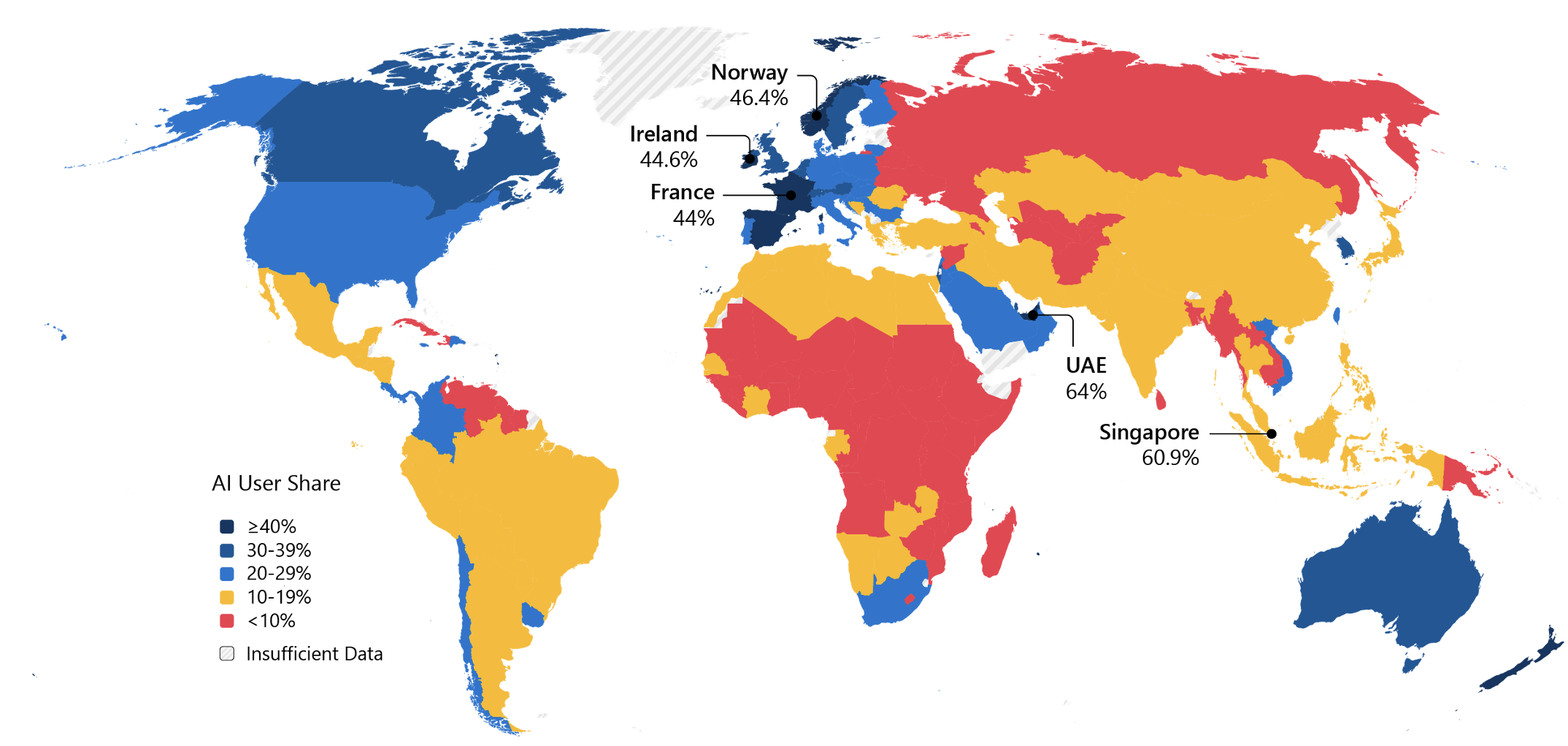
Population-level usage measures what share of working-age adults use AI tools regularly. This is the metric where the UAE leads at 70% and Singapore follows at 63%.
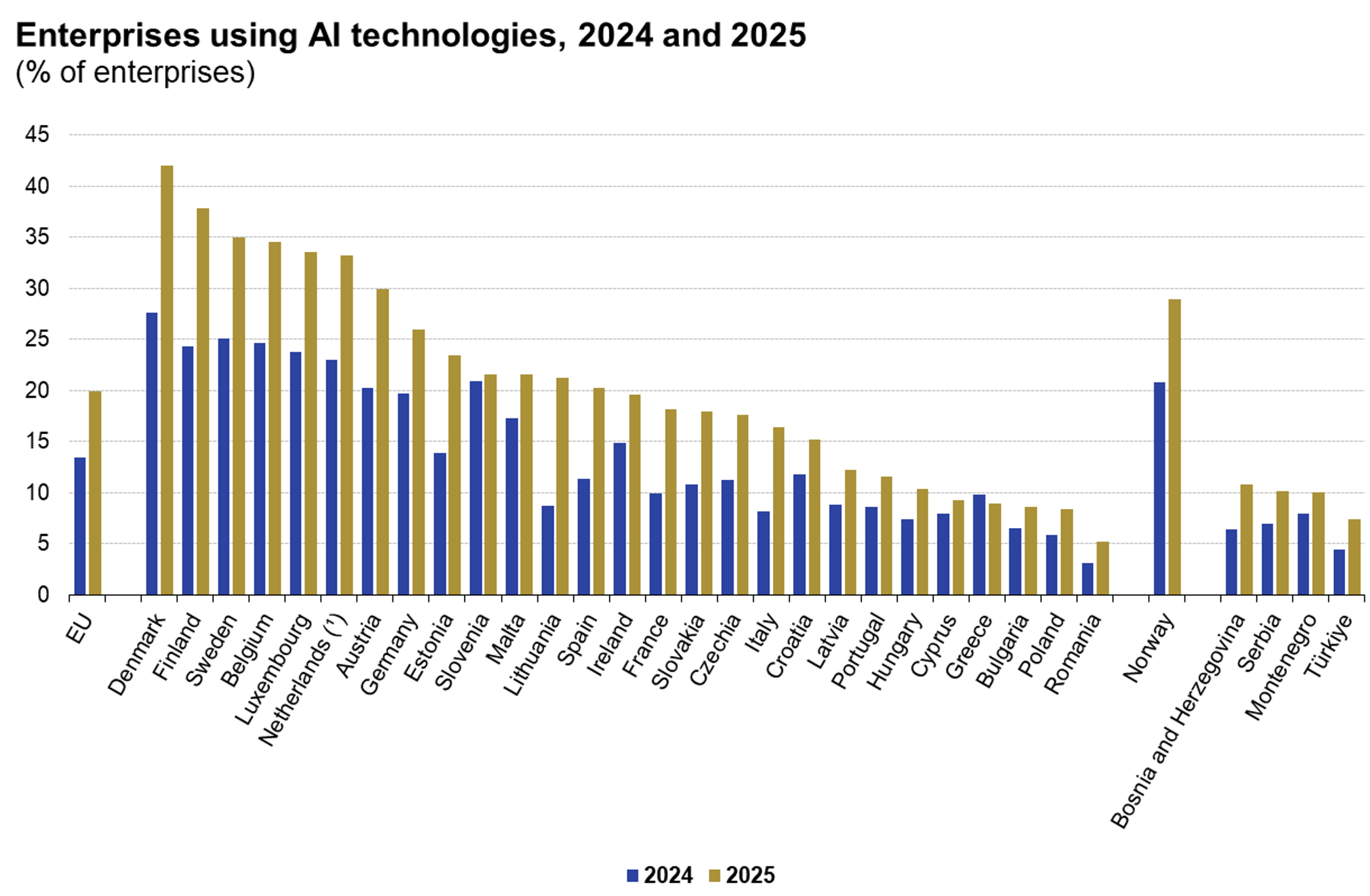
Enterprise adoption measures what share of companies with ten or more employees use at least one AI technology in production. This is the metric where Denmark leads Europe at 42% and the EU27 average sits at 20%.
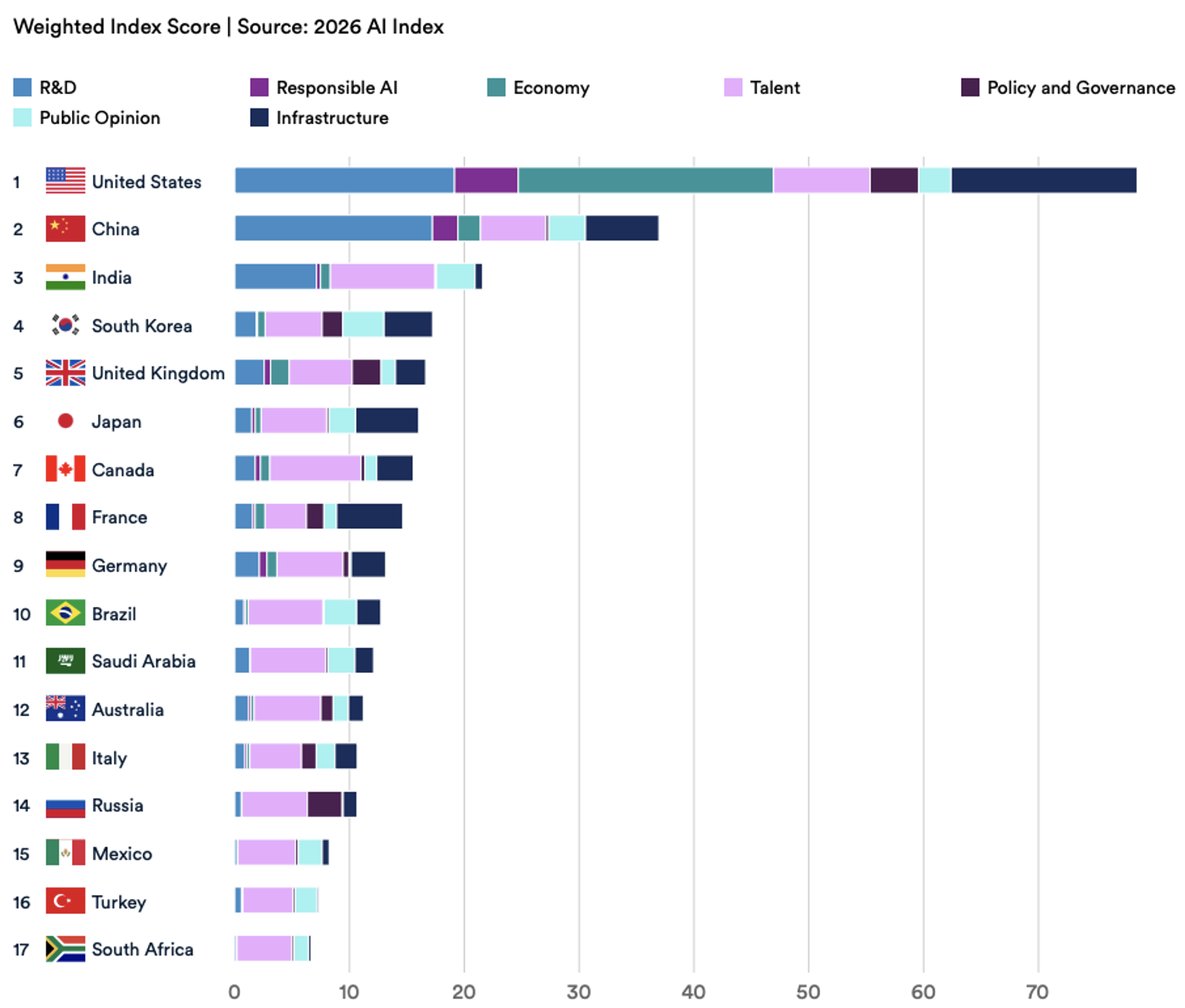
AI readiness scores combine governance, infrastructure, talent, and investment into a composite index. On this measure, the United States leads globally at 87.03, followed by Singapore at 84.25 and South Korea at 79.98.
These are not the same measurement. A country can lead on population usage and lag on enterprise readiness. Kenya is the clearest current example of this, leading sub-Saharan Africa on ChatGPT consumer adoption while sitting eighth in enterprise AI deployment across the continent.
The metric that matters most for business leaders is enterprise deployment: the share of organisations running AI in production at a scale that affects business outcomes. That is the number this analysis prioritises.
The Global Leaders: What They Share
United Arab Emirates and Singapore dominate population-level usage, at 70% and 63% respectively, not because of size or natural advantage but because of deliberate, funded, early action. The UAE has invested in AI infrastructure since 2017 through a national strategy targeting nine sectors. Singapore committed $743 million through 2027 and implemented mandatory AI literacy programs in schools before most countries had drafted their first AI policy.
The United States leads on AI readiness at 87.03 and on private investment at $109.1 billion, which is twelve times China’s $9.3 billion and twenty-four times the United Kingdom’s $4.5 billion. Enterprise AI adoption in the US exceeds 85%. What the US does not lead on is adoption velocity. US AI adoption growth was 19% between H1 2025 and Q1 2026.
China presents the most complex picture. Enterprise AI deployment reaches 58%, second only to India globally. The country leads in AI applications in manufacturing, computer vision, and autonomous systems, with autonomous vehicles being tested in 16 cities, the highest number worldwide.
India has achieved 57% enterprise AI adoption, supported by 87% of enterprises actively using AI solutions according to the NASSCOM AI Adoption Index. More than 500 Global Capability Centres dedicated specifically to AI have made India the world’s primary destination for operational AI talent.
Europe: Two Continents Inside One Region
Europe’s AI story is not one story. It is two, separated by geography, industrial structure, and the speed at which national strategies have translated into engineering reality.
The Northern European Leaders
Denmark leads EU enterprise AI adoption at 42.0%, followed by Finland at 37.8%, Sweden at 35.0%, Belgium at 34.5%, and the Netherlands at 33.2%.
Broadband penetration exceeds 95% across the Nordic and Benelux markets. National strategies with attached funding — AI Sweden, Denmark’s Digital Growth Plan, Finland’s AI Programme, Belgium’s AI 4 Belgium — converted ambition into procurement and deployment within defined timelines. Large STEM talent cohorts provided the engineering workforce to execute. And early private sector investment in cloud AI platforms built the infrastructure before it was needed at scale, rather than scrambling to build it as demand arrived.
The critical insight from Northern Europe is not that these countries are more technologically sophisticated. It is that they treated AI infrastructure the same way they treated broadband infrastructure two decades earlier: as a national competitiveness investment requiring coordinated public and private action, not a series of individual enterprise decisions.
The Western European Middle Tier
France, Germany, and the Netherlands occupy the most strategically interesting position in the European landscape. Each has significant AI investment, mature technology sectors, and sophisticated enterprise markets.
France leads Western Europe on the AI Readiness Index at 79.36, followed by the United Kingdom at 78.88, the Netherlands at 77.23, Germany at 76.90, and Finland at 76.48. Western Europe performs best in the Data and Infrastructure pillar, averaging 81.91, which is 21 points above the global average.
France ranked last in the Public Sector AI Adoption Index 2026. 74% of French public servants said AI could not perform any part of their work. Only 27% reported organisational investment in AI tools. This is the same France that has invested €1.5 billion in AI infrastructure and positions AI as a strategic tool for national competitiveness.
Germany mirrors this dynamic in the private sector. Strong AI research output, significant corporate investment, but a persistent gap between strategy documents and production deployment. The management practices research from the St. Louis Fed is illuminating here: countries with higher quality management practices show significantly higher AI adoption rates, with a correlation of 0.83.
The UK, post-Brexit, is navigating a more complex regulatory environment than its EU counterparts while maintaining genuine strengths in AI research and financial services AI applications.
The Eastern European Laggards
Romania sits at 5.2% enterprise AI adoption, Poland at 8.4%, and Bulgaria at 8.5%, all significantly below the EU27 average of 20%.
These are not countries where AI has been tried and found difficult. They are countries where the preconditions for enterprise AI adoption — digital infrastructure, AI talent density, management practices that support technology adoption — have not yet reached the threshold required for deployment at scale. The risk for Eastern European enterprises is not that they will adopt the wrong AI strategy. It is that the gap between them and Northern European competitors will compound through the same mechanism that has driven productivity divergence since the 1990s: the countries that adopt new technologies earliest tend to pull further ahead rather than converging with later adopters.
Africa: The World’s Most Misread AI Market
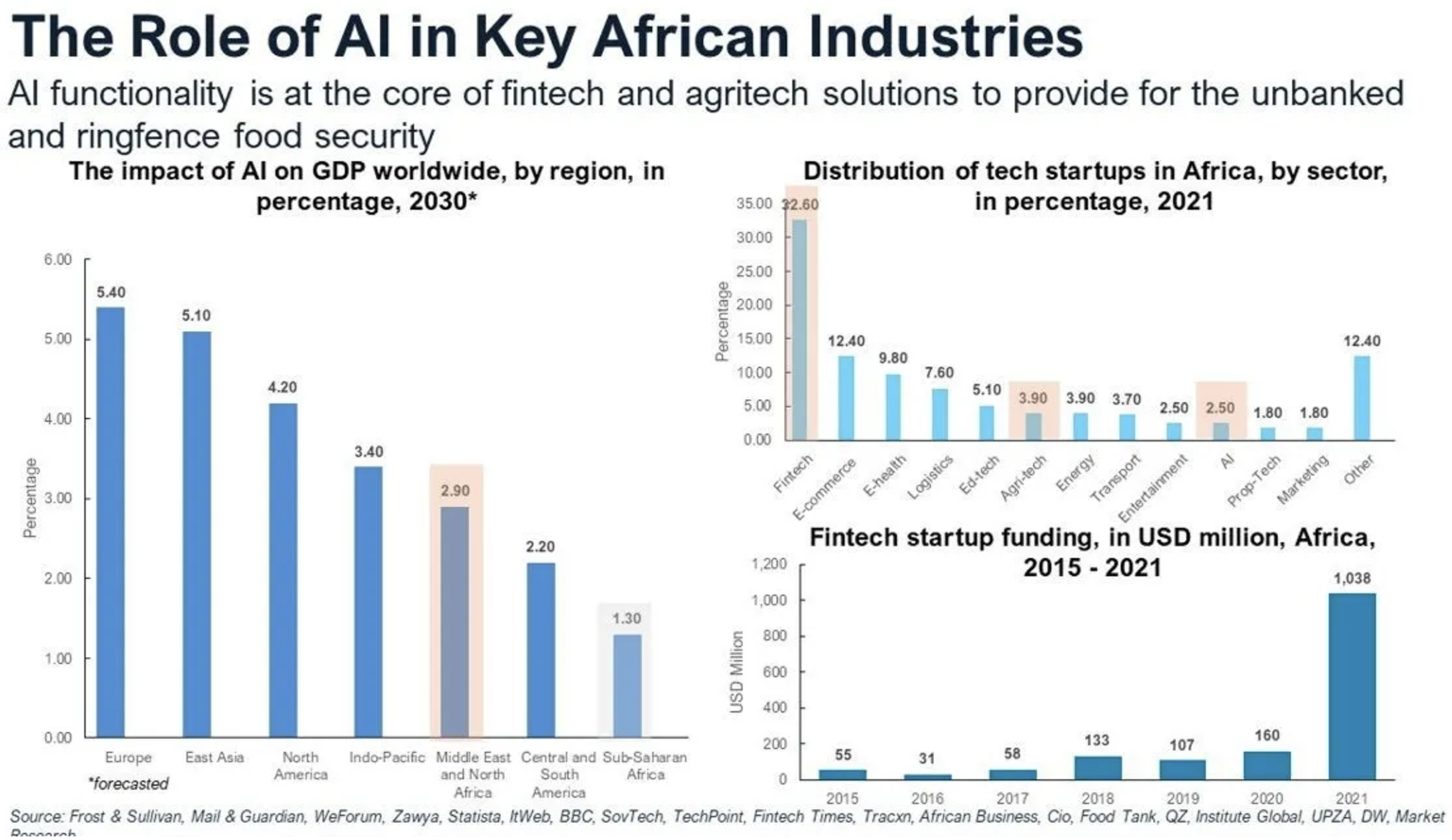
Africa’s AI adoption story is told, almost universally, through the lens of deficit. Infrastructure gaps, talent shortages, data quality problems. That framing is factually accurate and strategically misleading. It captures the constraints while missing the trajectory.
AI in Africa is projected to reach $16.5 billion by 2030. Up to 230 million digital jobs are projected in sub-Saharan Africa by the same date. The question for enterprise technology leaders in Africa is not whether this market will develop. It is whether their organisations will be positioned to capture it or to watch it develop around them.
South Africa: The Continental Leader With a Concentration Problem
South Africa leads Africa in generative AI adoption, with 23.1% of the working-age population using generative AI in Q1 2026, ranking 46th globally.
South Africa’s lead reflects genuine structural advantages: 74.7% internet penetration, a $6.8 billion IoT market, progressive data policies including POPIA, and a private sector technology investment culture that has no peer on the continent. The country’s financial services and mining sectors have been early and serious adopters of enterprise AI.
The constraint South Africa faces is concentration. AI capability, infrastructure, and talent are heavily concentrated in Johannesburg and Cape Town. The gap between those centres and the rest of the country mirrors the gap between South Africa and the rest of Africa: the leading edge is genuinely impressive, and the distribution of that capability is severely limited.
Kenya: The Paradox Market
Kenya presents the most intellectually interesting AI adoption picture on the continent, and the one that is most consistently misread.
Kenya achieved a 42.1% ChatGPT usage rate among internet users by July 2025, driven by 92% smartphone penetration and a grassroots, mobile-first adoption model. This figure far surpasses South Africa at 15.3%, Egypt at 9.8%, and Nigeria at 8.2% on consumer AI usage.
Microsoft and G42 committed $1 billion to build Kenya’s first major AI data centre, targeting a 100 megawatt facility at Olkaria powered by geothermal resources. The project has stalled over payment guarantees and power constraints, with the 2026 target window now uncertain.
The opportunity is real. Kenya attracted $1.04 billion in tech investment in 2025, a 72% increase year on year. Safaricom has committed Sh66 billion to build AI infrastructure across the region. The enterprises that build their engineering foundations now, before the infrastructure arrives at scale, will be positioned to deploy at speed when it does.
Nigeria: Scale and Structural Tension
Nigeria’s AI story is defined by two competing realities operating simultaneously.
Nigeria ranks second in Africa for AI startups and secured $218 million in venture capital investment in 2023. The country is targeting 43% of Africa’s $136 billion in projected AI productivity gains by 2030. Lagos has a technology ecosystem that has produced globally competitive fintech and commerce platforms.
Yet Nigeria’s generative AI adoption sits at 10.1% of the working-age population, ranking behind South Africa, Namibia, Botswana, and Egypt among African nations.
The structural tension in Nigeria is the distance between what its startup ecosystem has built and what its broader enterprise market has adopted. The fintech sector, exemplified by companies like Moniepoint and Paystack, has been genuinely innovative in building AI-powered financial services. The wider enterprise market, including multinationals operating in Nigeria, has been slower to move beyond pilots.
Nigeria is aiming for 43% of Africa’s AI productivity gains by 2030, with a focus on skills training and cloud infrastructure investment. The question is whether the organisational and infrastructure work will happen in parallel with the investment, or whether Nigeria will repeat the pattern of other markets where capital arrives before the engineering foundation is ready to use it.
Ghana: The Long-Term Play
Ghana has a decade-long AI strategy running from 2023 to 2033, with a growing focus on local language AI tools. Nigeria and Ghana both record enterprise AI adoption rates of 9.3%. Google opened its AI Research Centre on the African continent in Accra in 2023, signalling external confidence in Ghana’s trajectory.
Ghana’s approach is distinguished by its time horizon. A ten-year strategy is an unusual commitment in a region where technology policy cycles tend to be shorter. If the strategy is executed with consistency, Ghana has the potential to build an AI capability that is structurally different from the catch-up efforts of larger markets: built deliberately over time rather than assembled in response to competitive pressure.
The Structural Gap That No Ranking Captures
Across every region examined in this analysis, one pattern recurs with enough consistency to constitute a finding rather than an observation.
The gap between AI adoption and AI production readiness is wider than any ranking captures. Countries and organisations that score well on adoption metrics have often achieved that score by deploying AI in low-stakes, easily measurable contexts: customer service automation, content generation, data processing tasks with high tolerance for error. The harder work — deploying AI in production systems that affect business-critical decisions, that must be governed, audited, and maintained over time — is lagging behind adoption numbers by a significant margin.
Deloitte projects 2026 as the year the gap between the promise and reality of AI narrows, as the industry makes further movements toward getting AI to scale.
That projection is conditional. The narrowing will happen for organisations that treat AI as an engineering discipline requiring infrastructure, governance, and sustained operational ownership. It will not happen automatically for organisations that have accumulated a portfolio of pilots without building the production layer.
Where Incresco Works
This analysis has mapped the global AI divide along two dimensions: who is ahead and who is falling behind. The more operationally significant question for technology leaders is: what does it take to move from one category to the other?
The answer is almost never more AI tools, more model selection research, or more strategy workshops. It is the engineering work that sits between ambition and production. Data infrastructure that can support AI at scale. Review processes calibrated to where AI-generated output carries the most risk. Compliance infrastructure that demonstrates rather than claims governance. Architecture decisions that perform on the infrastructure that exists, not the infrastructure that was promised.
This is the work Incresco does with technology organisations across Europe and Africa. Not the strategy phase and not the post-launch support. The engineering layer that determines whether an AI investment produces business outcomes or sits in a pilot forever.
For European technology leaders, the immediate pressure is the August 2026 EU AI Act enforcement deadline. For African technology leaders, the immediate pressure is building the engineering foundation before the infrastructure wave arrives and the market window narrows.
Both pressures have the same solution: starting with what you actually have, not what the roadmap assumed you would have by now.
If you are a CTO or CEO navigating either of these contexts, the conversation worth having is not about which AI strategy is right. It is about whether your engineering organisation can execute it. That question has a specific, assessable answer. And identifying the infrastructure gap is where the work begins.
Related: OpenAI Dots vs Meta Muse: What Always-On AI Agents Mean for Developers and Enterprises
Incresco is a technology consulting firm working with global enterprises on AI engineering, production readiness, and regulatory compliance. This analysis was compiled in May 2026 using data from Eurostat ICT Enterprise Survey 2025, Microsoft Global AI Diffusion Q1 2026, Stanford AI Index, CEPR 2026, St. Louis Fed 2026, McKinsey Global AI Survey 2025, Mastercard AI in Africa 2025, Tech In Africa, TechTrendsKE, Capital FM Kenya, and KICTANet.
Related Articles
Engineering
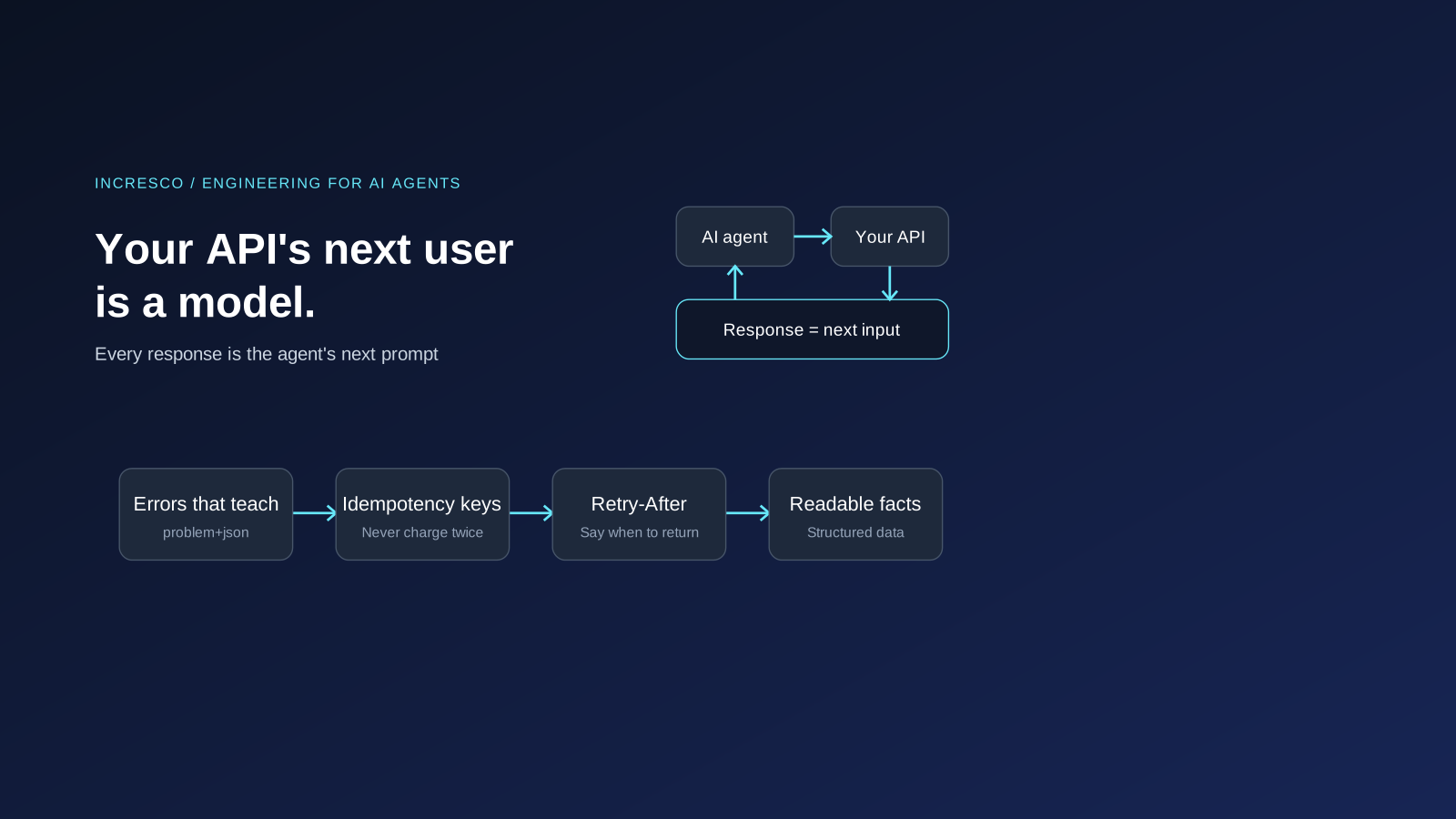
Your API's Next User Is a Model: Agent Experience (AX) for Engineers
AI agents call your API and treat each response as their next prompt. Engineering for them: clear errors, idempotency keys, rate limits and MCP tools.
Read Insight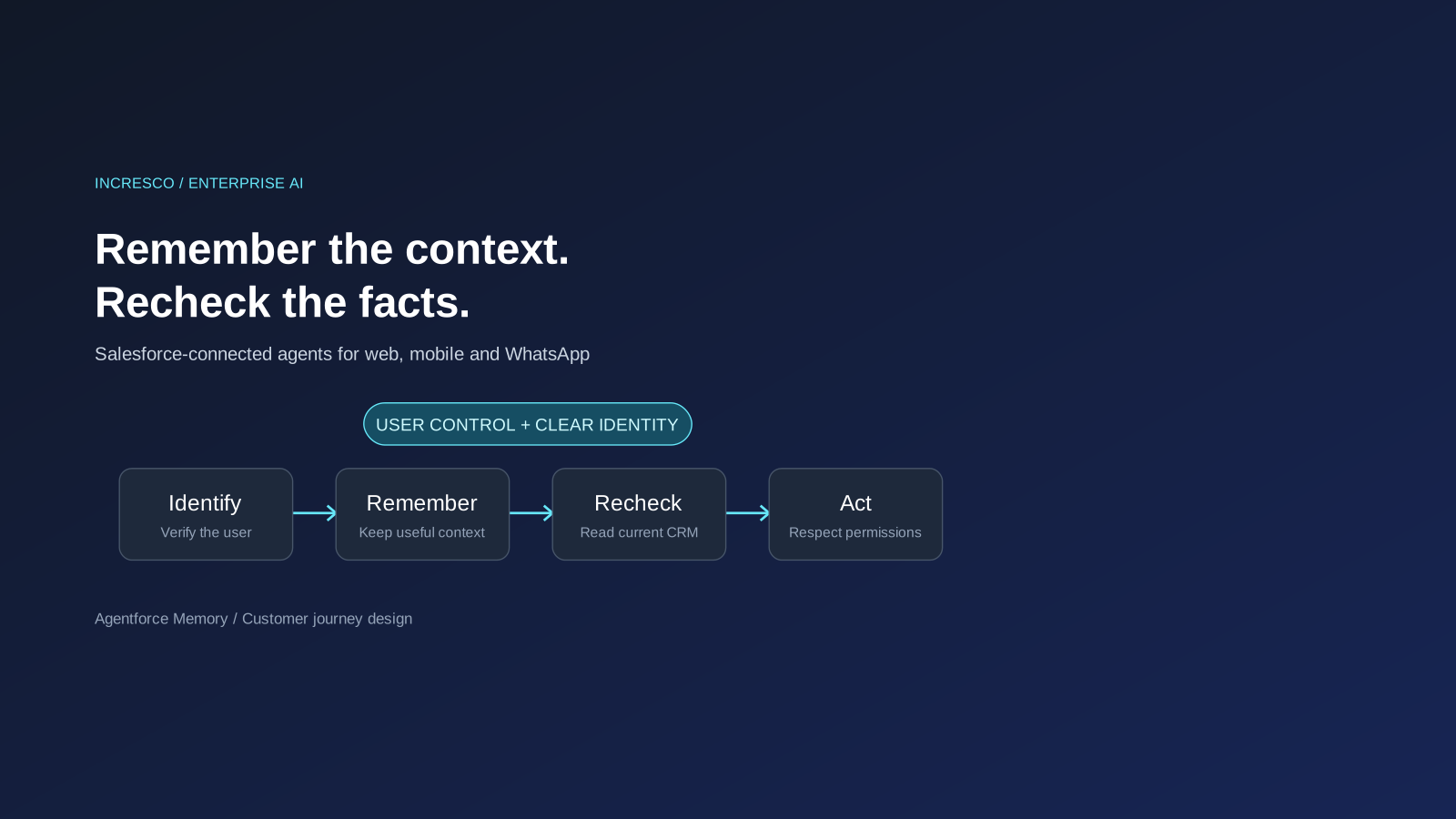
Business
Agentforce Memory: What Salesforce and WhatsApp AI Agents Should Remember
Salesforce's new Agentforce Memory engineering article explains persistent context. What should web, mobile and WhatsApp AI agents remember, refresh or forget?
Read Insight